

Hydroxytyrosol Extraction Guide: Methods, Solvents, Uses
To recover hydroxytyrosol, start by checking whether your olive material contains the free compound or precursors that need conversion. Olive mill wastewater can contain about 50–300 mg/L of free hydroxytyrosol, but that range is not a guaranteed yield.
In this guide, I explain how to:
- Choose and prepare your source: wastewater, pomace, leaves, fruit, or brines.
- Select a process: water or ethanol–water extraction, assisted methods, or precursor conversion.
- Purify and test: remove unwanted material, measure hydroxytyrosol, and check contaminants and storage stability.
- Plan the end use: meet U.S. requirements for foods, supplements, or cosmetics, while accounting for water, energy, solvents, and waste.
My starting rule: <u>judge the tested ingredient - not just the extraction yield.</u> This is controlled industrial work, not a kitchen procedure, and lab antioxidant activity does not prove health effects in people.
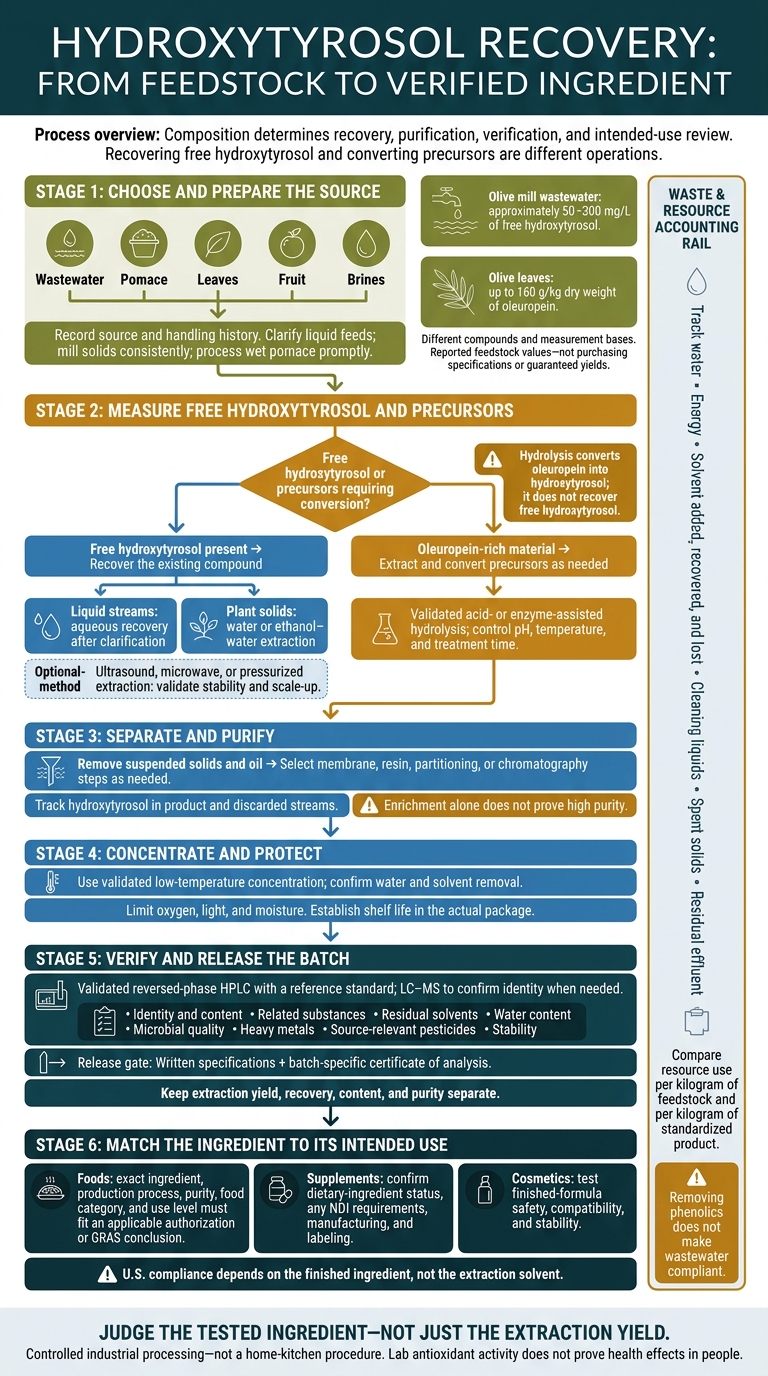
Hydroxytyrosol Extraction: Source to Verified Ingredient
Choosing and Preparing Source Materials
Measure free hydroxytyrosol separately from its precursors. Oleuropein is a common olive phenolic precursor to hydroxytyrosol. Leaf extract rich in oleuropein needs conversion, while wastewater may already contain free hydroxytyrosol.
Choose a recovery route that fits the source.
Olive Mill Wastewater, Pomace, Leaves, and Fruit
Reported concentrations range from approximately 50–300 mg/L of free hydroxytyrosol in olive mill wastewater to as much as 160 g/kg dry weight of oleuropein in leaves. These values apply to specific feedstocks. They aren't purchasing specifications or guaranteed yields. For each feedstock, check whether hydroxytyrosol is already free or remains bound in precursors.
| Source | Advantages | Key limitations | Best-fit process |
|---|---|---|---|
| Olive mill wastewater | Liquid feed; no initial drying needed | High water content; variable solids, oil, salts, and microbial stability | Aqueous recovery and membranes after clarification |
| Wet pomace | Abundant residue; suited to processing near the mill | High moisture; fast biochemical changes; difficult transport and storage | Aqueous extraction after milling and dilution |
| Dry pomace | Easier storage, transport, and standardized batching | Energy-intensive drying; possible phenolic changes; residual oil and solids | Solvent extraction |
| Olive leaves | Rich in phenolics; relatively easy to dry and mill | Composition varies with cultivar, season, and leaf age | Solvent extraction with precursor conversion |
| Fresh or processed fruit | Useful for studying cultivar and maturity effects | Competes with food uses; variable and seasonal | Aqueous or solvent extraction |
| Olive brines and related liquid residues | Liquid feed compatible with membrane recovery | Salts, preservatives, and contaminants complicate recovery | Membranes with desalting and fouling control |
Once you've chosen the source, handling affects how much phenolic material remains available.
Storage, Milling, and Pretreatment
Handling affects free hydroxytyrosol, precursor conversion, and downstream cleanup. Record cultivar, maturity, harvest date, origin, harvest method, time to milling, mill settings, moisture, storage time and temperature, drying conditions, particle size, and any added chemicals.
Screen or centrifuge wastewater to remove coarse solids and oil. Process wet pomace promptly, refrigerate it briefly, or use validated drying conditions. Avoid uncovered storage. For dried material, document drying time, product temperature, final moisture, and water activity.
In a fresh two-phase pomace study, verbascoside declined by about 70% after 17 days at 39°F (4°C), while hydroxytyrosol increased. The authors recommended avoiding open storage and limiting refrigerated holding to approximately 7–10 days.
Mill solids consistently without making a powder so fine that it's difficult to filter. Add only enough water to make pomace flowable, and record the solid-to-water ratio, mixing time, and temperature. Separate solids before membrane treatment. Extra dilution means more liquid to concentrate.
For material rich in precursors, validate the reagent, pH, temperature, and treatment time.
An olive mill wastewater process combined β-glucosidase pretreatment with microfiltration, ultrafiltration, and concentration; the ultrafiltration permeate reached 7.2 g/L hydroxytyrosol after concentration.
With the source prepared, the next decision is solvent and process choice.
sbb-itb-4066b8e
Choosing Extraction Methods and Solvents
Solvent, extraction method, and precursor conversion are separate choices. Choose the combination that provides the most usable hydroxytyrosol after purification - not simply the highest crude extraction yield.
Liquid streams generally suit aqueous recovery, while dry plant solids suit solvent-based or assisted extraction. The right approach also depends on whether the source contains free hydroxytyrosol or mainly oleuropein.
| Method | Compatible sources | Solvent or medium | Strength | Main limitation | Scalability |
|---|---|---|---|---|---|
| Conventional solid–liquid extraction | Leaves, pomace, fruit | Water or ethanol–water | Straightforward equipment | Co-extraction of impurities; solvent demand | High with solvent recovery |
| Ultrasound-assisted extraction (UAE) | Leaves, pomace, fruit | Water or ethanol–water | Improves solvent penetration and mass transfer | Uneven sound distribution; heating | Requires scale-up validation |
| Microwave-assisted extraction (MAE) | Pomace, leaves | Water or ethanol-based media | Fast heating and extraction | Localized overheating; pressure; degradation | Requires engineered systems |
| Pressurized liquid extraction (PLE) | Plant solids | Pressurized water or solvent | Faster extraction at elevated temperatures | Specialized pressure-rated vessels | Equipment-dependent |
| Liquid–liquid partitioning | Clarified wastewater, aqueous hydrolysates | Ethyl acetate and water | Separates hydroxytyrosol from some aqueous impurities | Requires clean phase separation; solvent residues | Enclosed industrial systems |
| Supercritical-fluid extraction | Olive solids | Carbon dioxide, usually with a polar co-solvent | Useful for less-polar constituents | Poor hydroxytyrosol solubility in carbon dioxide alone | High-pressure equipment required |
Use depends on validated purity and compliance, not the method alone.
Solvent choice determines selectivity, the residues that need removal, and suitability for food-grade production.
Water, Ethanol–Water, and Other Solvents
Water and ethanol–water are the main starting points for food-oriented production, provided you use appropriate grades and validated processing. Check what comes out with the hydroxytyrosol, including sugars, salts, color, and degradation products.
Record solvent composition, contact time, filtration losses, and recovery efficiency. A concentrated crude extract can still contain impurities.
| Solvent | Role and selectivity | Limits and cost considerations | Recovery requirements | End-use considerations |
|---|---|---|---|---|
| Water | Dissolves hydroxytyrosol and other polar compounds | Low solvent cost; concentration can use large amounts of energy | Remove water; manage co-extracted impurities | Food-oriented with contamination controls |
| Ethanol–water | Adjustable polarity for plant phenolics | Flammable; recovery adds equipment costs | Recover ethanol and verify residues | Food or pharmaceutical grade as appropriate |
| Ethyl acetate | Partitions hydroxytyrosol from aqueous streams | Flammable; requires reliable, clean phase separation | Recover solvent and test final residues | Suitability depends on validated removal and intended use |
| Methanol | Laboratory extraction and analytical work | Toxicological concerns | Controlled laboratory handling and disposal | Not a food-production solvent |
Ultrasound, Microwave, and Pressurized Extraction
Too much ultrasound treatment can cause heating, foaming, or degradation. Microwave and pressurized extraction need temperature monitoring and pressure controls, plus pressure-rated vessels where applicable. Validate compound stability under the operating conditions you select.
Converting Oleuropein to Hydroxytyrosol
Hydrolysis converts oleuropein into hydroxytyrosol; it does not recover free hydroxytyrosol. Acid-assisted processing needs controlled pH and corrosion-resistant equipment. Enzyme-assisted processing can provide milder, more selective conditions, but feasibility depends on enzyme activity, cost, and reaction time.
Monitor pH throughout conversion. Neutralize acid-treated material when needed, and account for the salts that neutralization creates. Limit excessive heat, oxygen exposure, and holding time to reduce degradation. After extraction or conversion, move on to separation, concentration, and residue removal.
Purification and Quality Testing
After extraction or hydrolysis, purification and testing determine whether the ingredient is usable, stable, and within specification. Purification turns a crude extract into an ingredient with measured properties.
| Stage | Objective | Key control point |
|---|---|---|
| Preparation | Remove stones and debris; control batch variability | Record source and handling history |
| Extraction or hydrolysis | Confirm that the process produced free hydroxytyrosol | Verify free hydroxytyrosol content |
| Primary separation | Reduce suspended solids and oil droplets | Use settling, centrifugation, or coarse filtration while limiting oxidation |
| Membrane or resin purification | Reduce sugars, proteins, salts, pigments, and larger phenolics | Track stream composition, membrane flux, pressure, and resin breakthrough |
| Concentration | Increase hydroxytyrosol content without excessive heat damage | Use vacuum evaporation, membranes, or other low-temperature methods; monitor recovery |
| Final testing | Confirm identity, potency, purity, safety, and stability | Release only against written specifications and a batch-specific certificate of analysis |
Each stage reduces impurities. Testing then checks whether the fraction still matches the target profile.
Filtration, Membranes, and Resin Separation
Centrifugation and coarse filtration remove bulk solids and protect finer separation steps. But they do not fully purify hydroxytyrosol. Control centrifuge speed and residence time, filter pore rating, pressure differential, temperature, and oxygen exposure. To spot losses, document turbidity, solids content, filtrate volume, and hydroxytyrosol concentration before and after clarification.
For membrane purification, test both the permeate and retentate. Membrane behavior varies by system, so track flux, pressure, temperature, and recovery. Fouling can reduce throughput and change selectivity.
When membrane cleanup isn't enough, resins and chromatography add selectivity. Resins capture phenolics from dilute aqueous extracts. A water wash removes sugars and salts, while food-compatible ethanol–water elutes hydroxytyrosol and related phenolics. Monitor breakthrough - the point when target compounds escape the resin - and validate regeneration.
Liquid–liquid partitioning can reduce selected impurities, but it requires solvent selection, emulsion control, solvent recovery, and residual-solvent testing. Chromatography can separate hydroxytyrosol from tyrosol, oleuropein derivatives, and hydroxytyrosol acetate. Still, a hydroxytyrosol-rich fraction may contain tyrosol, sugars, salts, and other phenolics. Enrichment alone does not prove high purity.
Concentration, Storage, and Analytical Testing
Use vacuum evaporation, membrane concentration, or other low-temperature methods to limit heat exposure. Confirm final water and solvent removal.
Once the target fraction is concentrated, stability depends on packaging and storage. Both should limit exposure to oxygen, light, and moisture. Establish shelf life by testing each formulation in its actual package. Under defined conditions, track hydroxytyrosol content, degradation products, color, odor, and moisture.
Keep extraction yield, recovery, content, and purity separate. Each measures something different. Maintain a mass balance across the product, discarded streams, and residues, and state whether results are reported as received or on a dry basis.
Use validated reversed-phase HPLC with a reference standard, and use LC–MS to confirm identity when needed. Test total phenolics separately. Also test related substances, residual solvents, water content, microbial quality, heavy metals, and source-relevant pesticides, with limits set for the intended application.
The certificate of analysis should list the lot, methods, limits, results, units, dates, and approval. These results support batch release decisions for food, supplement, or cosmetic use against the applicable specifications and requirements.
Uses and U.S. Safety Requirements
After purification and testing, match the ingredient to a lawful use. U.S. compliance depends on the finished ingredient, not the extraction solvent. Olive-leaf and wastewater-derived extracts may need different regulatory support.
Food, Supplement, and Cosmetic Uses
For foods and beverages, check that the ingredient’s exact identity, production process, purity, food category, and use level fit an applicable food-additive authorization or GRAS conclusion.
FDA GRN 1182 supports hydroxytyrosol as an antioxidant at 5 mg per serving in specified beverages, fats and oils, and fruit and vegetable juices.
For beverages, test taste, solubility, precipitation, and stability under the formula’s pH, heat, and packaging conditions.
Supplement rules differ from food rules, even when both use the same source ingredient. Confirm that the ingredient qualifies as a dietary ingredient under U.S. rules and whether it requires a new dietary ingredient (NDI) notification at least 75 days before marketing. A food-use GRAS conclusion does not automatically cover a concentrated supplement. Manufacturers must also meet applicable manufacturing and labeling requirements.
For cosmetics, test the finished formula - not just the ingredient - for irritation, sensitization, light stability, oxidation, preservative compatibility, and microbial control.
Research Evidence and Health-Claim Limits
Claims must match the evidence behind the ingredient. Lab activity is not proof of human benefit. Even a change in a biomarker does not prove that an ingredient prevents heart disease, diabetes, dementia, or infection.
Supplement structure/function claims require substantiation, the FDA disclaimer, and notification within 30 days of first marketing. Disease claims can trigger drug requirements. Review labels, websites, ads, and retailer copy before launch.
Use categories and claim limits also affect solvent recovery, energy use, and residue handling.
Waste Management and Process Trade-Offs
Purification solves one problem but creates new waste streams. Assess hydroxytyrosol recovery by both ingredient value and waste burden. Recovering it from wastewater or pomace may reduce disposal needs, but it doesn't eliminate waste. Track every output: recovered ingredient, wash water, solvent losses, spent solids, and residual effluent. Concentration moves pollutants into another stream; it doesn't remove them.
Water, Energy, Solvent Recovery, and Residues
Count the water used for dilution, washing, solvent preparation, membrane cleaning, and resin regeneration. Include contaminated cleaning and regeneration liquids in that accounting. Track the energy used to dry wet pomace, heat extracts, concentrate liquids, and recover ethanol. For ethanol systems, measure how much solvent is added, recovered, and lost. Provide suitable storage, ventilation, and ignition controls.
Removing phenolics does not make wastewater compliant. The remaining wastewater can still contain organic matter, salts, suspended solids, and cleaning chemicals. Test final effluent separately against applicable limits. Direct discharges generally require National Pollutant Discharge Elimination System controls; municipal sewer discharges may require pretreatment. Confirm treatment outlets for concentrates and cleaning liquids. Test spent pomace before composting, digestion, or other reuse.
Matching the Process to the Source and Use
Resource use and disposal needs help determine which route to choose. As with source selection, the decision depends on feedstock moisture and composition, required purity, available utilities, production scale, and regulatory pathway. Use this qualitative comparison to narrow the options for each source, then check suitability with pilot data.
| Route | Compatible source | Water/energy load | Solvent recovery | Equipment needs | Cleanup burden | Intended application |
|---|---|---|---|---|---|---|
| Aqueous extraction and membranes | Wastewater or wet pomace extracts | Concentration drives energy demand | Low solvent burden; cleaning water needs treatment | Screens, pumps, membranes, tanks, cleaning system | Co-concentrated salts, sugars, acids, and phenolics | Early-stage recovery or research fractions |
| Ethanol–water extraction | Dried or partially dried pomace, leaves, or fruit | Drying often drives the main energy load | Required at scale, with loss and flammability controls | Extractor, filtration, evaporator or distillation, solvent-rated storage | May need decolorization, resin separation, or chromatography | Food or supplement development with validated solvent-residue controls |
| Adsorption/resin separation | Clarified wastewater or extract | Pumping and regeneration; concentration may dominate | Depends on elution solvent | Resin columns, pumps, regeneration and collection systems | Eluate needs processing; wash water needs treatment | Selective hydroxytyrosol enrichment |
| Oleuropein conversion and separation | Leaves, fruit, pomace, or extracts containing measurable oleuropein | Reaction, heating, and separation add demand | Depends on reaction and purification chemistry | Reactor, pH controls, filtration or membranes, analytical equipment | Removal of byproducts and unconverted compounds | Standardized hydroxytyrosol with verified conversion |
Before scaling up, pilot-test multiple harvest lots or wastewater batches against the source type, purity target, and available disposal routes. Record recovery and purity along with water and energy use, solvent consumption and recovery, cleaning frequency, processing time, input–output balance, and residual-stream volumes.
Compare resource use per kilogram of feedstock and per kilogram of standardized product. Choose a route based on the source, process, and verified quality - but only after pilot data confirm quality and disposal routes are documented for every remaining stream.
Conclusion: Source, Process, and Verified Quality
Hydroxytyrosol recovery comes down to three decisions: source, process, and verification. Olive mill wastewater, pomace, leaves, and fruit each need different handling. Use direct extraction for free hydroxytyrosol and conversion when oleuropein is the main precursor. Choose solvents and methods for the intended use - not yield alone.
Verify every finished batch with validated HPLC or LC-MS testing. Check purity, residues, and stability, and weigh resource use and waste treatment alongside purity and cost.
The intended use determines the compliance path once quality is verified. Recovery decisions need a traceable source, a validated process, and verified batch quality. Industrial recovery is not a home-kitchen procedure: solvent handling, purification, contamination control, and analytical verification require controlled facilities.
FAQs
How do I estimate hydroxytyrosol recovery costs?
Estimate usable hydroxytyrosol output based on your measured yield . Include all recovery costs: solvents and other inputs, solvent handling, food-grade suitability, drying or pretreatment, energy, labor, and separation or polishing.
Divide total costs by kilograms of recovered hydroxytyrosol or usable extract - not by the amount of solvent or enzyme used. Pilot-test representative lots to account for differences in yield.
What hydroxytyrosol purity does my product need?
Your product’s target hydroxytyrosol purity depends on the recovery route. For food, supplement, or cosmetic use, the guide describes thermal pretreatment followed by column chromatography to reach 94%+ hydroxytyrosol purity.
In solvent-based extraction workflows, resin cleanup can bring phenolic purity to about 30–60% by weight. That figure refers to the total phenolic fraction - not hydroxytyrosol alone.
How can I compare hydroxytyrosol certificates of analysis?
Compare matched feedstocks and operating conditions - not concentration alone. Normalize yield to dry solids or initial phenolic mass. Use calibrated HPLC or LC-MS results, with consistent units and the same reporting basis: free compounds or totals after hydrolysis. Check detection limits, too.
Don’t use total phenolic assays to measure hydroxytyrosol precisely. Verify testing for heavy metals, microbes, and residual extraction solvents to confirm compliance with U.S. food requirements.