

IFOAM vs EU Organic: Standards Comparison
IFOAM recognizes organic standards; EU Organic sets binding rules for organic claims. Before buying or selling, I check the certificate’s product and facility scope - not just the logo.
EU Organic generally requires at least 95% organic agricultural ingredients by weight for an organic sales description, along with other conditions. For U.S. sales, I also check USDA labeling and import rules. EU certification alone does not permit a “USDA Organic” claim.
Here’s what I compare:
- Production: Allowed orchard inputs, soil practices, and conversion dates.
- Processing: Milling, blending, bottling, ingredient approval, and separation from conventional products.
- Certification: Who checks compliance, inspection schedules, and certificate scope.
- Records: Lot codes, supplier documents, and inventory checks from orchard to bottle.
- Labels and trade: Organic-content thresholds, logo rules, origin statements, and import paperwork.
Quick Comparison
| Check | IFOAM | EU Organic | USDA NOP |
|---|---|---|---|
| Role | Recognizes standards; does not certify each producer | Sets EU production, certification, and labeling rules | Sets U.S. production, certification, and labeling rules |
| Conversion | Depends on the recognized standard | Generally three years for olive orchards | No prohibited substances for 36 months before harvest |
| Processing and inspections | Depend on the certification scheme | EU handling rules and annual controls apply | NOP handling rules and annual inspections apply |
| Organic label threshold | Depends on the standard and market | At least 95% organic agricultural ingredients, plus other conditions | At least 95% for “organic”; 70% for “made with organic” |
| Market access | Recognition alone does not grant access | EU rules and import conditions apply | U.S. rules and import conditions apply |
My bottom line: <u>match the certificate, lot records, and label to the destination market</u>. For olive oil and balsamic vinegar, I check quality separately - organic certification does not establish extra virgin grade, flavor, or antioxidant content.
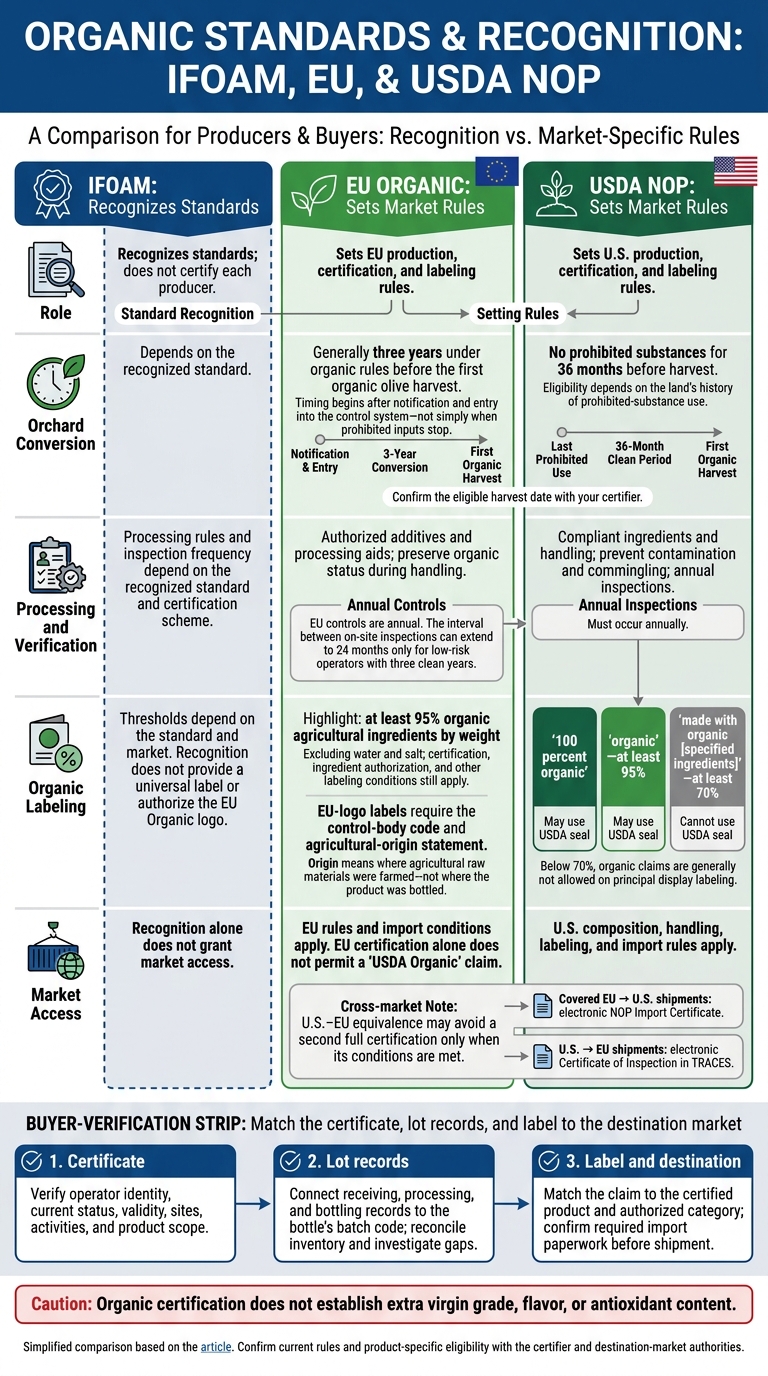
IFOAM vs EU Organic vs USDA: Key Differences
Production and Processing Requirements
At the orchard and mill, EU Organic and USDA NOP differ in input approval, conversion timing, processing controls, and organic-content thresholds. This comparison covers USDA NOP, an IFOAM-recognized standard, and EU Organic under Regulation (EU) 2018/848.
| Requirement | EU Organic | USDA NOP |
|---|---|---|
| Orchard inputs | Authorized substances only, within use restrictions | NOP-compliant inputs that meet applicable National List requirements and are documented in the Organic System Plan |
| Conversion period | Generally three years under organic rules before the first organic olive harvest | No prohibited substances for 36 months before harvest |
| Soil and biodiversity | Maintain fertility, prevent erosion, and support biodiversity | Maintain or improve soil condition; prioritize preventive cultural, mechanical, physical, and biological practices |
| Processing | Use only authorized additives and processing aids, and keep their use to a minimum | Use compliant ingredients and handling practices; prevent contamination and commingling |
| Organic content | At least 95% of agricultural ingredients by weight, plus other conditions, for organic sales descriptions | At least 95% organic content for “organic”; 70% for the separate “made with organic ingredients” category |
For growers, these differences shape which inputs they can use and when their harvest can qualify as organic.
Olive Orchard Inputs and Conversion Periods
Start with prevention. Both systems support cover crops, mulching, pruning, mechanical weed control, and habitat for beneficial insects. Before buying fertilizers or pesticides, check the formulation, active ingredients, intended use, and restrictions with your certifier. A product described as “natural” doesn't automatically qualify. Keep labels, approval correspondence, and application records for restricted permissions or exceptions.
The conversion clock also starts differently. In the EU, timing begins after notification and entry into the control system - not simply when prohibited inputs stop. USDA eligibility depends on the land’s history of prohibited-substance use. Confirm the eligible date with your certifier before scheduling harvest.
Orchard practices also determine what can be accepted, mixed, and labeled at the mill.
Organic Rules for Milling, Blending, and Bottling
Once fruit reaches the mill, the focus shifts from inputs to handling. Milling, blending, filtration, and bottling must preserve organic status. Check processing aids that contact the product and cleaning materials, track tanks and lots, and document cleaning between organic and conventional runs. Connect incoming fruit to mill records, then reconcile quantities received, bottled, sold, and lost.
Review the whole formula - not just the oil or vinegar base. For infused oils, check herbs, extracts, flavors, and carriers. For balsamic vinegars, check grape must, wine vinegar, colorants, sweeteners, and preservatives. The EU’s 95% rule applies to agricultural ingredients by weight, excluding water and salt. Meeting that threshold supports EU logo eligibility, but it doesn't replace certification, ingredient authorization, or required labeling rules.
sbb-itb-4066b8e
Certification, Inspections, and Records
Meeting production rules is one step. Proving compliance is the next.
Certification covers a named operator, site, and product scope. IFOAM recognition alone does not certify a bottle.
| Issue | EU Organic | IFOAM-recognized private or national certification |
|---|---|---|
| Registration | Operators generally notify the relevant authority or control body before starting organic activity. | Operators declare sites, activities, products, and subcontractors when applying. |
| Inspection responsibility and frequency | Control authorities or bodies check compliance and issue certificates. EU controls are annual. The interval between on-site inspections can extend to 24 months only for low-risk operators with three clean years. | Approved or accredited certifiers audit and certify. Inspection frequency, follow-up visits, sampling, and group controls depend on the scheme and risk. |
| Certification documents | Certificates identify the operator and certified activities or product categories. | Scope documents identify the operator, sites, activities, products, standard, validity, and exclusions. |
| Violations | Corrective action, claim restrictions, suspension, or withdrawal may apply. | Corrective action, claim restrictions, scope reductions, suspension, or withdrawal depend on the scheme. |
| Market recognition | Supports EU organic claims and applicable equivalence arrangements. | IFOAM recognition alone does not ensure market acceptance. Destination rules, the standard, and certifier accreditation determine eligibility. |
Who Inspects and Certifies Producers
Under EU rules, operators generally need certification before making organic claims. Check that it covers every relevant orchard, mill, bottler, and subcontracted activity. IFOAM recognition does not authorize use of the EU Organic logo.
Group certification under IFOAM-recognized standards may use an internal control system. The group tracks member compliance, while the external certifier audits the system and selected members. Confirm that the destination market accepts the certification and that its scope covers orchard, mill, and bottling activities.
If an inspection finds noncompliance, isolate affected lots, stop unsupported claims, and notify the certifier. Document the affected products, corrective action, who is responsible, and the completion date.
For buyers, the key check is simple: does the certificate match the exact orchard, mill, bottler, and product lot?
Traceability From Orchard to Bottle
Keep production plans, input logs, supplier certificates, transaction and batch records, cleaning procedures, storage controls, and approved label files. These records support label claims and cross-border sales.
A bottle’s batch code should lead back through bottling, processing, and receiving records. Verify the supplier’s legal identity, certified scope, and validity dates. Check its current certification status, then keep database checks or written confirmation with the batch file.
Where required, reconcile opening inventory, receipts, sales, and losses by product, status, facility, and period. Include closing inventory, work-in-process, and transfers. Investigate unexplained differences before releasing affected batches.
Organic Labels and International Sales
EU Organic sets the rules for label use. IFOAM helps compare standards but does not provide a universal label. Certification and traceability are only part of the job: the packaging must also meet the destination market’s rules.
| Claim or logo | Required evidence | Issuing certifier or control body | Destination-market limits |
|---|---|---|---|
| EU organic claim, with or without logo | EU-compliant certification and required label details; logo use requires at least 95% organic agricultural ingredients by weight | Authorized control body or control authority | Claims are regulated even without the logo. EU certification alone does not permit U.S. claims. |
| In-conversion | Compliance with EU conversion rules for plant-origin products | EU control body or control authority | Not certified organic; cannot use the EU organic logo. |
| USDA Organic seal | USDA-compliant certification; qualifying imports also require an electronic NOP Import Certificate | USDA-accredited certifier or recognized EU certifier | U.S. composition, handling, and import rules still apply. |
EU Organic Logo and Label Requirements
The EU logo is generally required on EU-produced, prepacked organic products sold in the EU. It’s optional for non-prepacked products and imports that meet EU import rules. Uncertified products, in-conversion products, and products that fail the applicable composition or processing rules cannot use it.
Labels using the logo must include the control-body code and an agricultural-origin statement. That statement shows where the agricultural raw materials were farmed - not where the product was bottled.
For olive oil blends, infused oils, and balsamic vinegars, check whether the finished product qualifies and identify organic ingredients as required. The 95% logo threshold applies to agricultural ingredients, not every ingredient in the formula. “Natural,” “pure,” premium-quality, sourcing, or sustainability language does not establish organic status. For exports, also check whether the destination market accepts the claim.
Selling and Importing Organic Products in the United States
For U.S. sales, labels and import paperwork must meet USDA rules. USDA separates products into “100 percent organic,” “organic” (at least 95%), and “made with organic [specified ingredients]” (at least 70%). The first two categories may use the USDA seal; the last cannot. Below 70%, organic claims are generally not allowed on principal display labeling.
The U.S.–EU equivalence arrangement can remove the need for a second full certification if the product’s origin, processing, scope, and certified activities meet its conditions. The table’s NOP Import Certificate requirement applies to covered EU-to-U.S. shipments. U.S.-to-EU shipments require an electronic Certificate of Inspection in TRACES.
Before shipment, check current USDA, EU Commission, and certifier rules. Make sure bottle labels, product titles, descriptions, and metadata match the authorized U.S. category. An EU logo alone does not permit advertising a product as “USDA Organic.”
Conclusion: Follow Market Rules and Check Certification
IFOAM sets global organic principles; EU Organic sets binding market rules. Choose your compliance route based on the destination market, buyer contracts, product formulation, handling activities, and certification scope - not just the framework’s name.
After choosing the standard, check the certificate, records, and labels before selling.
Checklist for Producers and Retailers
Review conversion, inputs, processing, storage, labeling, and import/export records. Budget for certification, inspections, sampling and testing when required, recordkeeping, and corrective actions. Ask the certifier for a written scope and quote.
| Area | Producer responsibility | Buyer check |
|---|---|---|
| Certificates | Keep certification current for every site, product, and activity. | Verify the operator, certifier/control-body ID, status, and product scope. |
| Labels | Keep label files and evidence supporting claims. | Match claims to certification; reject unsupported wording. |
| Traceability | Connect supplier records, production logs, inventory, and sales by lot. | Match lot codes to invoices and shipping records; investigate gaps. |
| Purchasing risk | Document segregation, holds, and corrective actions. | Include rejection, recall, and cost-shift terms in contracts. |
Before signing contracts or changing labels, review current EU organic rules, IFOAM materials, and USDA guidance. Use consolidated EU texts for reference, not as replacements for the operative rules. Check trade requirements again before shipment.
What Buyers Should Check on Olive Oil and Balsamic Vinegar
For olive oil and balsamic vinegar, the certificate must match the exact product, lot, and label. Review olive oil harvest dates, storage, and quality documents separately. Organic certification does not establish flavor, antioxidant content, how recently the oil was produced, or extra virgin grade.
At Big Horn Olive Oil, check the product page, label, lot number, and certification documents. Ultra Premium is a quality term, not an organic claim. If organic status hasn’t been verified, don’t make organic claims.
Before buying, verify certification status, product scope, and lot traceability for each bottle.
FAQs
How do I choose an organic standard for export?
Start with your destination market’s requirements. For exports to the United States, use a USDA-accredited certifier or a formal equivalency agreement. Link every shipment to a valid electronic NOP Import Certificate. For the EU, follow Regulation 2018/848, which often requires non-EU producers to comply directly.
Check that your certification body is approved for your target market. Keep your Organic System Plan, harvest and sales logs, and chain-of-custody records up to date to show compliance.
How can I verify an organic certificate is valid?
Look for the USDA Organic seal or EU organic leaf logo on the packaging, along with the accredited certifying agency’s name. EU-certified products should also display a certifier code, such as IT-BIO-XXX, near the logo.
Then confirm the operation’s status in the USDA Organic Integrity Database for U.S. operations or OFIS/TRACES for EU-certified or imported goods. For IFOAM-related certifications, check the issuing body’s accreditation in the IFOAM Global Organic Certification Directory.
Can adding flavors change a product’s organic status?
Yes. Organic certification depends on how a product is made, how its ingredients are handled, and what it contains. Both EU and USDA-style labeling require at least 95% organic ingredients for an “Organic” claim. The remaining ingredients must be organic when available or come from approved substances. Prohibited additives could invalidate the claim.
Products marketed as organic in the EU must also follow EU rules and labeling requirements linked to the 95% threshold.