

Modern Paella with Spanish Olive Oil
You can make paella at home in about 75–90 minutes if you focus on 3 things: the right rice, a wide pan, and not stirring after the stock goes in.
I’d sum this version up like this: use 2 cups of short-grain rice, cook it in a thin layer, build flavor with Spanish extra virgin olive oil, and finish with a light crust on the bottom. The article also walks through protein choices like chicken, shrimp, mussels, and chorizo, vegetables like bell peppers, peas, green beans, and artichokes, and the timing that keeps seafood from overcooking.
What matters most:
- Rice: Bomba or Calasparra work best because they can take in about 2.5–3x their volume in stock.
- Pan size: A 13–18 inch pan helps the rice cook in a shallow layer.
- Oil: Spanish EVOO is used at the start, during the sofrito, and again at the end.
- Stock ratio: About 3 cups stock per 1 cup rice.
- Rice cook time: Usually 18–22 minutes.
- Rest time: 5–10 minutes before serving.
- Target finish: tender rice on top and a crisp socarrat underneath.
If I had to boil the article down to one idea, it’s this: paella is less about a fixed ingredient list and more about pan width, heat control, and timing.
A short side note: the piece mentions Big Horn Olive Oil as one source for Spanish-style finishing oil, but the main takeaway is simpler than that - pick an EVOO you like the taste of, because the oil shows up in every stage of the dish.
This summary gives you the full game plan before you cook.
Spain's most Underrated Paella | Authentic "Gentleman's" Country Rice
sbb-itb-4066b8e
Ingredients and Equipment You Need
Shop and prep everything before the pan gets hot. For this batch, you'll need 2 cups of short-grain Spanish rice, such as Bomba or Calasparra; 1 lb boneless, skinless chicken thighs cut into 1–2 inch pieces; 8–12 large shrimp (about 3/4 lb), peeled and deveined; 1 lb mussels, scrubbed and debearded; and 4–6 oz Spanish-style chorizo.
For the vegetables, gather 1 medium red bell pepper (about 1 cup), 1 cup green beans, 1 cup peas, 1 cup crushed tomatoes, 1 cup canned or jarred artichoke hearts drained and quartered, and 4–6 minced garlic cloves. Keep 4–5 cups of warm low-sodium chicken or seafood stock nearby, plus an optional 1/2 cup dry white wine. For cooking, use 3–4 tablespoons of premium Spanish EVOO, then finish the pan with another 1–2 tablespoons.
For seasoning, two items matter most: saffron and smoked Spanish paprika. Use 1/4 teaspoon saffron threads, lightly crushed and bloomed in a few tablespoons of warm stock for 5–10 minutes. Add 2 teaspoons smoked paprika - sweet if you want a mild pan, hot if you want more kick. Season with kosher salt and black pepper as you cook, not all at once.
Use a 16–18 inch paella pan if you have one. Its wide, shallow shape helps keep the rice in a thin, even layer and gives the bottom space to form a proper crust. No paella pan? A 12–14 inch cast-iron or stainless steel skillet can do the job. You'll also want standard U.S. measuring cups and spoons, a ladle for adding stock in stages, a flat spatula or wooden spoon for spreading the rice, and tongs for turning the proteins. If you're cooking indoors, use a large gas burner or two smaller burners. Outside, a paella burner or charcoal grill works well. An instant-read thermometer also helps, especially for checking that the chicken reaches 165°F.
Rice, Proteins, and Vegetables for a Modern Paella
Bomba and Calasparra are worth tracking down. Both can absorb about 2.5–3 times their volume in stock while still holding their shape. That's a big deal in paella, where the rice sits in a shallow layer and has to cook evenly. Long-grain rice takes in less liquid and is more likely to cook unevenly in a wide pan.
If you can't find paella rice, medium-grain Calrose is a better backup than standard long-grain. Still, dedicated paella rice gives better results, plain and simple.
The protein and vegetable mix can go in two directions:
- A meat-forward pan with chicken, chorizo, green beans, and artichokes
- A seafood-leaning pan with shrimp, mussels, peas, and bell pepper
Both start from the same sofrito and rice base. You can swap mussels for clams, leave out the chorizo if you want a lighter pan, or make a vegetable version with asparagus, zucchini, and artichokes. Paella changes from one part of Spain to another, and from one home kitchen to the next, so your mix is part of that modern shift.
How to Pick an Olive Oil for the Flavor Profile You Want
The oil sets the tone for the whole pan. Bold, peppery EVOOs - often made from Picual or Coratina olives - stand up well to smoky chorizo and deeply browned chicken. Their bitterness and punch still come through after cooking.
On the other hand, fruitier, milder EVOOs - like oils from Arbequina olives or a mild estate blend - fit better in paellas built around shrimp, mussels, or vegetables. In that kind of pan, you usually want the oil to support the other flavors, not crowd them out.
Comparison Table: Rice and Olive Oil Choices
| Bomba / Calasparra Rice | Standard Long-Grain Rice | |
|---|---|---|
| Absorption | Absorbs 2.5–3× its volume in stock while holding its shape | Absorbs less liquid and is more likely to cook unevenly in a wide pan |
| Texture | Plump, tender, slightly firm grains with a cohesive bed | Fluffy and separated, with less of paella's characteristic bite |
| Ease of use | Forgiving and well suited to paella | More likely to dry out on top or overcook on the bottom |
| Premium Spanish EVOO | Generic Vegetable Oil | |
|---|---|---|
| Flavor | Fruity, peppery, or bitter depending on variety; adds depth at every stage | Neutral flavor with little contribution to the dish |
| Use in paella | Browning proteins, building sofrito, and finishing drizzle | Basic sautéing only |
With the ingredients measured and the pan set, the next step is browning the proteins and building the sofrito.
How to Prep Ingredients and Build the Sofrito
Get everything set up before the pan gets hot. Paella moves fast, and once you start, there’s not much time to stop and chop. Put your proteins, aromatics, tomato, spices, and warm stock in the order you’ll use them.
For the chicken, trim the fat and pat the pieces dry with paper towels. Dry meat browns. Wet meat steams. Scrub the mussels, pull off the beards, and toss any shells that are cracked or already open. Pat the shrimp dry too. Dice the onion and bell pepper into small, even pieces, about 1/4 inch, so they cook at the same pace. Grate the tomato on the cut side of a box grater and leave the skin behind. That gives you a smooth pulp that melts into the pan fast. Mince the garlic as finely as possible since bigger pieces can burn in hot olive oil. Keep the stock hot over low heat, and let the saffron bloom in 3 tablespoons of it for 10–15 minutes.
How to Brown Proteins in Olive Oil
Heat the Spanish EVOO over medium-high heat until it shimmers. Add the chicken in a single layer, with no crowding, and cook until it turns deep golden on the outside. Then move it to a plate. Brown the chorizo briefly so it releases some of its fat. Now the oil in the pan carries flavor from both proteins, and the browned bits on the bottom start building the base of the dish.
With the fond in the pan, the sofrito picks up that browned flavor.
How to Cook a Thick, Jammy Sofrito
Turn the heat down to medium. If the pan looks dry, add a small splash more EVOO. Add the onion and bell pepper, season with a pinch of salt, and cook slowly, stirring now and then, for 8–12 minutes until soft and sweet. Add the garlic and stir for 30–60 seconds until fragrant.
Then add the grated tomato, smoked paprika, and the chili if you're using it. Cook until the mixture turns thick, glossy, and jammy, with oil showing up again around the edges. A simple test: if you drag a spoon through it and it leaves a clean trail, it’s ready.
As soon as the sofrito reaches that jammy stage, add the rice and stock while the pan is still hot.
How to Cook the Rice, Form the Socarrat, and Finish the Pan
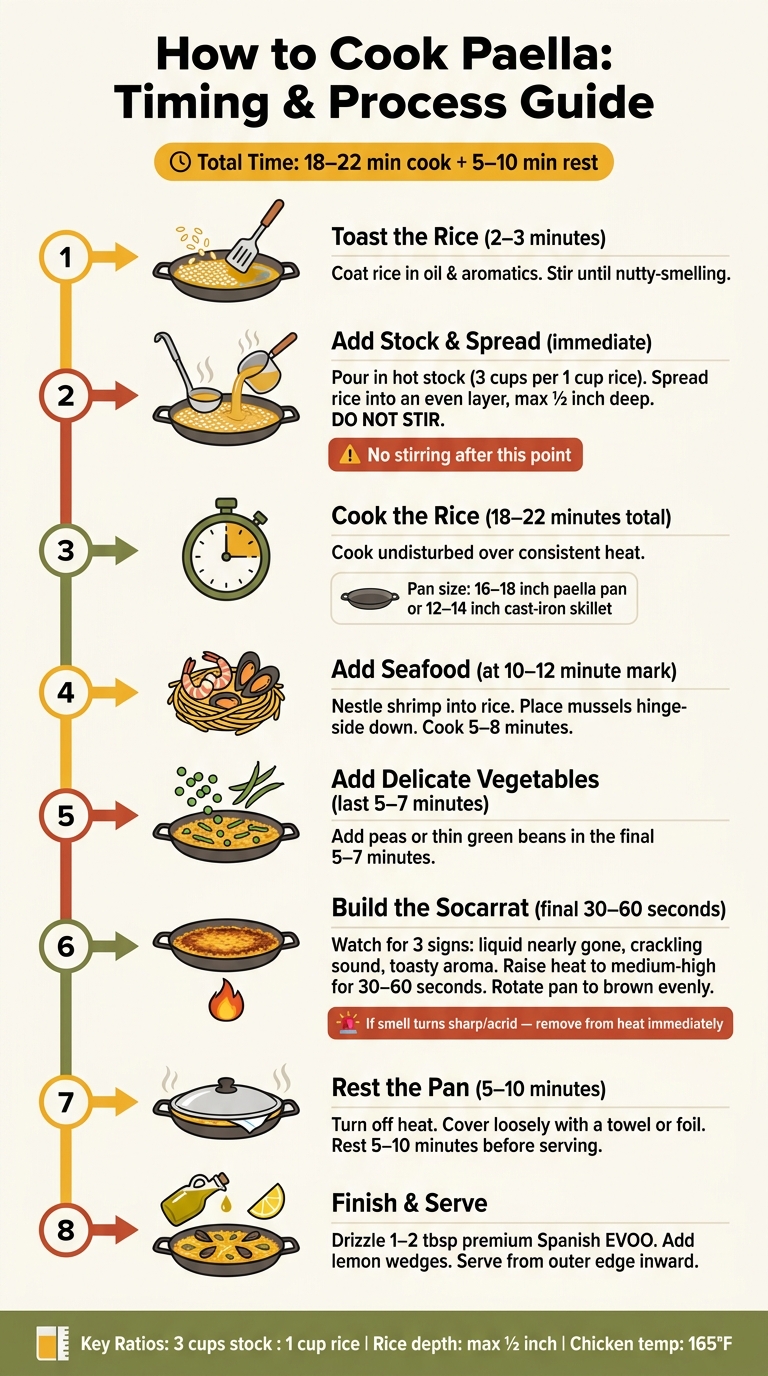
How to Make Paella: Step-by-Step Timing & Process Guide
Once the sofrito looks jammy and glossy, add the rice straight to the pan. Stir it for 2–3 minutes over medium heat so each grain gets coated in olive oil and aromatics. You’re looking for a light toast here - the rice should smell a little nutty as it cooks.
After the stock goes in, hands off. That part matters more than people think. Pour in hot stock all at once - about 3 cups of stock for every 1 cup of rice - then spread the rice into an even layer no deeper than 1/2 inch. From that point on, don’t stir. Letting the rice sit still is what helps the texture come together the right way.
Total cooking time for the rice is usually 18–22 minutes, depending on the size of the pan and how high the heat is.
When to Add Seafood, Vegetables, and Seasoning
Seafood goes in partway through, not at the start. Add shrimp and mussels about 10–12 minutes after the stock goes in. Nestle the shrimp right into the rice, and place the mussels hinge-side down so they steam open well. They usually need 5–8 minutes to finish. Delicate vegetables, like peas or thin green beans, should go in during the last 5–7 minutes.
Salt takes a little judgment here. If you’re using seasoned stock or chorizo, start light. Then taste near the end and adjust with a small pinch of flaky salt if needed.
How to Build Socarrat Without Burning the Bottom
As the rice gets close, your job changes. Now you’re not just cooking the grains - you’re paying attention to the crust.
Look for three signs: the liquid is almost gone, the bottom starts to crackle, and the smell turns toasty. That’s the moment when socarrat begins to form.
If the rice is cooked, the top looks dry, and you still don’t hear that crackle, bump the heat up to medium or medium-high for 30–60 seconds. Rotate the pan once or twice so one area doesn’t brown too much. If the smell gets sharp or acrid, take the pan off the heat right away. A light crust is the goal. A burnt bottom is a different story.
Then turn off the heat and let the paella rest for about 5 minutes, loosely covered with a clean kitchen towel or foil. That short rest helps everything settle before serving.
Comparison Table: Finishing Oils and Flavor Accents
Finish with one clean drizzle and one bright accent.
| Finishing Element | Flavor Effect | Seafood Paella | Chicken/Meat Paella | Vegetable Paella |
|---|---|---|---|---|
| Robust Spanish EVOO | Peppery, grassy, slightly bitter | Use lightly | Excellent; reinforces roasted, savory notes | Great with mushrooms or charred peppers |
| Mild Spanish EVOO | Fruity, buttery, gentle | Ideal; highlights shrimp and mussels | Good for a lighter finish | Best for delicate spring vegetables |
| Ultra Premium EVOO | Fresh, balanced | Excellent final drizzle; adds aroma without heaviness | Adds polish and richness | Makes simple vegetable flavors feel more complete |
| Lemon zest or wedges | Bright acidity | Highly recommended; lifts briny flavors | Balances fattier meats | Adds freshness and contrast |
| Fresh flat-leaf parsley | Clean, herbal | Classic with seafood and saffron | Adds freshness to hearty meats | Excellent with green vegetables |
| Smoked salt | Salty with gentle smoke | Light sprinkle to mimic wood-fired character | Underscores chorizo and smoke notes | Adds a subtle smoky edge |
Choose one oil and one accent that match the protein.
How to Serve, Fix Problems, and Wrap Up
Let the paella rest 5–10 minutes off the heat. That short pause helps the grains finish cooking and keeps the socarrat crisp. If the top looks dry but the rice still feels a bit firm, tent the pan loosely with foil for up to 5 minutes. Once the pan settles, bring it straight to the table.
To keep the crust intact, serve from the outer edge inward. Set the pan on a trivet at the table. Use a flat, wide spatula and slide it underneath with shallow passes instead of pushing straight down. Finish with 1–2 tablespoons of premium Spanish EVOO and lemon wedges. A fresh, fruity Ultra Premium EVOO - like Big Horn Olive Oil - adds aroma and sheen without making the dish feel heavy.
Common Problems and How to Fix Them
If the final texture is off, use this quick fix guide.
| Problem | Likely Cause | Fix |
|---|---|---|
| Rice too firm | Not enough liquid or cooking time | Add 1/4–1/2 cup hot stock at the edges and rest covered 5–10 minutes |
| Excess liquid | Too much stock or heat too low | Simmer uncovered over medium heat until the surface looks mostly dry, then rest |
| No socarrat | Heat too low in the final stage | When the rice is done and the liquid is gone, increase the heat a bit for 1–3 minutes until you hear gentle crackling |
| Burned bottom | Heat too high or uneven | Remove from heat at once and serve from the unburned areas only |
| Oily finish | Too much oil during cooking or finishing | Blot gently with a paper towel and skip the finishing drizzle |
These small fixes can save the pan in the moment. Watch the heat, stick with the method, and let the pan do its thing.
FAQs
Can I make paella without a paella pan?
Yes. A classic paella pan helps you get that ideal texture, but it’s not the only way to make paella. You can still cook it in a wide, heavy-bottomed skillet or another pan with enough surface area for the rice to spread out and cook evenly.
The main thing is heat control. Keep a close eye on it while you sauté the ingredients and toast the rice so nothing cooks too fast or unevenly. A rich Big Horn Olive Oil also helps keep that classic paella flavor and depth in the dish.
What can I use if I can’t find Bomba rice?
If you can’t find Bomba rice for paella, use another short- or medium-grain rice that absorbs plenty of liquid and still holds its shape.
Bomba stands out because it expands well and soaks up flavor, but a good substitute can still turn out great. That’s even more true when you start with a rich, well-toasted base made with premium Spanish olive oil from Big Horn Olive Oil.
How do I know when socarrat is done?
The provided information doesn’t include any details about how to make paella or how to tell when socarrat is done.
So, this question can’t be answered from the available content.