

Checklist for Hosting an Olive Oil Tasting Event
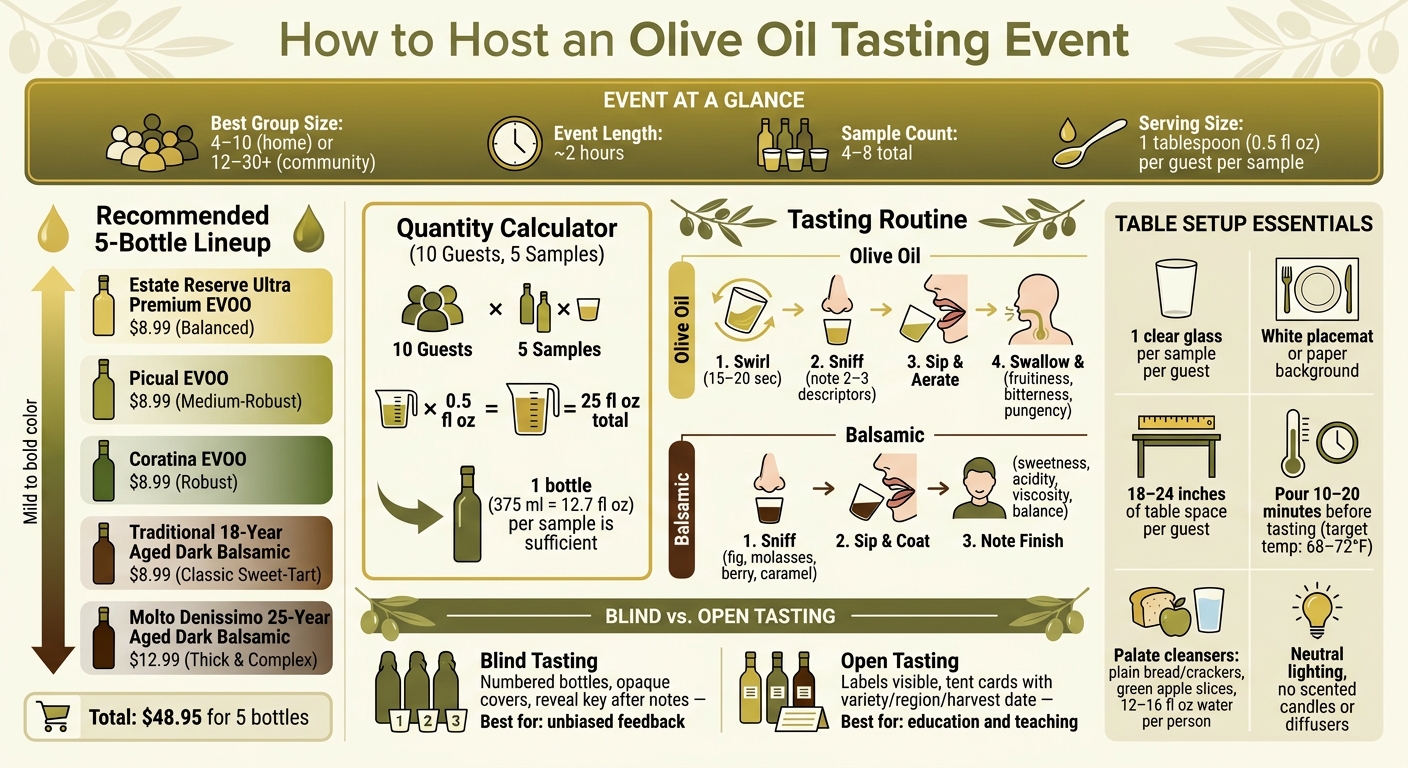
_You can host a solid olive oil tasting in about 2 hours with 4 to 8 samples, 1 tablespoon per guest per sample, and a total sample budget near _$48.95_ for a 5-bottle set._*
I’d keep the plan simple: pick a theme, invite guests 2 to 3 weeks ahead, pour in a mild-to-strong order, and give each person water, bread or crackers, apple slices, and a tasting sheet. For a group of 10 tasting 5 items, you’ll need about 25 fl oz total, and 375 ml bottles are enough for each sample.
Here’s the full idea in one view:
- Best group size: 4 to 10 at home, or 12 to 30+ in a shared space
- Best event length: about 2 hours
- Best sample count: 4 to 8 total
- Serving math: 1 tablespoon (0.5 fl oz) per guest, per sample
- Pour order: olive oils first, then balsamics; light before bold
- Table setup: one glass per sample, white background, neutral lighting
- Palate reset: plain bread or crackers, green apple slices, and 12 to 16 fl oz of water per person
- Tasting flow: smell, sip, aerate, note the finish
- After the event: seal bottles tight, store in a cool, dark pantry, and use leftovers in dressings, drizzles, or dessert
A few details matter most. Use clear glasses, leave 18 to 24 inches of table space per guest, and pour samples 10 to 20 minutes before tasting so they sit around 68°F to 72°F. If you want less bias, go blind with numbered bottles. If you want more teaching, show labels and product notes.
Home vs. Community Olive Oil Tasting: Quick Planning Guide
Discover the Art of Olive Oil Tasting with Mark and Chef Peter
Quick Comparison
| Part of the event | Small home tasting | Community tasting |
|---|---|---|
| Guest count | 4 to 10 | 12 to 30+ |
| Setup style | Casual | More structured |
| Host needs | One person can run it | Usually needs a lead person and printed sheets |
| Best length | 2 hours | 2 hours |
| Sample count | 4 to 6 works well | 4 to 8 works well |
| Tasting format | Blind or open | Blind or open |
If I were planning this, I’d focus on three things first: guest count, sample order, and serving math. Get those right, and the rest is mostly table setup and keeping the group moving at a steady pace.
Checklist: Select Samples and Estimate Quantities
Build a Balanced Olive Oil and Balsamic Lineup
Once you’ve picked a theme, trim your tasting down to a clean, easy-to-follow set of flavors. A good target is 4–8 samples: 3–4 olive oils and 2–3 balsamics. Move from mild to robust so each pour tastes distinct. That order matters. If you start with the boldest bottle, the softer ones can feel flat right after.
A practical lineup from Big Horn Olive Oil might look like this:
- Estate Reserve Ultra Premium EVOO (balanced)
- Picual EVOO (medium-robust)
- Coratina EVOO (robust)
- Traditional 18-Year Aged Dark Balsamic (classic sweet-tart)
- Molto Denissimo 25-Year Aged Dark Balsamic (thicker, more concentrated and complex)
Serve the lighter oils first, then work into the bolder oils and balsamics. Think of it like building a playlist: start smooth, then bring in the heavier notes.
Calculate Serving Amounts and Budget
Use 1 tablespoon (0.5 fl oz) per guest per sample. For 10 guests tasting 5 samples, that comes to 50 tablespoons, or about 25 fl oz total.
A 375 ml bottle holds about 12.7 fl oz, so one bottle per sample is enough for a 10-guest tasting. That gives you enough for the pours without going overboard.
Here’s the bottle cost for this five-item lineup:
| Product | Price |
|---|---|
| Estate Reserve Ultra Premium EVOO | $8.99 |
| Picual EVOO | $8.99 |
| Coratina EVOO | $8.99 |
| Traditional 18-Year Aged Dark Balsamic | $8.99 |
| Molto Denissimo 25-Year Aged Dark Balsamic | $12.99 |
At those prices, the full five-bottle lineup totals $48.95.
Check Freshness, Storage, and Product Notes
For extra virgin olive oil, the harvest date is your best freshness marker. Look for oils from the latest harvest. Big Horn Olive Oil cold-presses its EVOOs within 2 hours of harvest, which helps preserve bright aroma and polyphenol content.
Store bottles sealed, cool, and away from light. Pour small amounts, then recap between samples. That small step helps keep each bottle in better shape during the tasting.
Also note that both balsamics are from Modena, Italy. Once your lineup is locked in, pull together the glassware, tasting sheets, and palate cleansers.
sbb-itb-4066b8e
Checklist: Gather Supplies and Set Up the Space
Now that you've picked the lineup, set out the supplies and organize the table so each sample is simple to judge side by side.
Prepare Glassware, Tasting Sheets, and Palate Cleansers
Use one small, clear glass per sample, per guest. Clear glass makes it easy to check the color and clarity of each pour. Each person should also have a water glass, napkins, a pen or pencil, a small plate, a printed tasting sheet, and labels or stickers for sample numbers. Make sure the glasses are clean, free of odor, and covered until it's time to pour.
Your tasting sheet should include:
- A sample identifier
- Simple sensory prompts: fruitiness, bitterness, and pepperiness for oils; sweetness, acidity, and body for balsamic vinegars
- A 1–5 rating scale
- Space for pairing ideas and favorites
Add a short note at the top with the basic routine: smell, sip, aerate, then note flavor and finish.
For palate cleansers, keep plain baguette slices or unsalted crackers and green apple slices close by. Plan on about 4–6 pieces of bread or crackers and 3–4 apple slices per person. Cut the apples near serving time, then give them a brief dip in lightly salted water to slow browning. Set out 12–16 fl oz of chilled still or sparkling water for each guest.
Arrange the Table for a Clear Tasting Order
Place a white placemat or a sheet of plain white paper at each seat. That plain background helps guests judge color and clarity without distraction. Line the glasses up from left to right in the same order you plan to pour them.
Give each guest at least 18–24 inches of table width so there's enough room for glasses, the tasting sheet, water, and a plate without everything bumping together.
Keep the middle of the table open for shared bread, crackers, and apple slices. Use even, neutral lighting. Colored bulbs and dim light can throw off how the samples look. Also, skip scented candles, reed diffusers, incense, and heavily fragrant flowers. Those smells can drown out the subtle notes in a good EVOO. If you can, set up away from the kitchen when strong cooking smells are in the air.
Choose Between Blind and Open Tasting
At this stage, decide whether guests will taste without brand cues or see each product as they go.
Blind tasting is the better pick if you want honest, less biased feedback. Cover each bottle with an opaque sleeve or bag, then place numbered labels on both the bottles and the tasting sheets. Keep a private key that matches each number to its product, and reveal it only after guests have written down their notes.
Open tasting fits better when the event is meant to teach. Place each bottle just behind its matching glass so the label stays in view. Add small tent cards with the olive variety, region, harvest date, and intensity level. Those cards can tie back to the theme you picked earlier. They also help guests link what they taste to where the oil came from and how it was made.
In either format, pour samples 10–20 minutes before tasting so they can come to room temperature, ideally 68–72°F. That helps the aromas open up. Pour 1/4–1/2 teaspoon (1–2 ml) per guest, per sample. If the room is warm and you've poured ahead of time, loosely cover the glasses with small saucers or food-safe covers until the tasting starts.
Once the table is set and the samples are poured, move into the tasting routine.
Checklist: Guide the Tasting and Encourage Discussion
Guide guests through the tasting with a simple, steady routine. Keep the pace relaxed and easy. This is the moment when the lineup and table setup become a live tasting. Stick with the sample order you already chose: mild first, then bolder olive oils and balsamics.
Use a Simple Taste-and-Note Routine
Start with a short demo for the whole group before people begin on their own. For olive oil, use the four S's: swirl, sniff, sip, swallow. For balsamic, skip the warming step and focus on sniff, sip, coat, and note the finish.
Use the same flow for each sample.
For olive oil:
- Swirl: Cup the glass and swirl gently for 15–20 seconds.
- Sniff: Uncover and take one slow, steady breath. Write down 2–3 words - grassy, fruity, nutty, buttery - whatever comes to mind first.
- Sip and aerate: Take a small sip, about 1 teaspoon, then draw in a little air so the oil moves across the tongue.
- Swallow and note the finish: Notice what stays behind - fruitiness, bitterness, and pungency. It can help to breathe out gently through the nose to catch aromas that didn’t stand out on the first sniff.
For balsamic:
- Sniff: Note the aroma right away - fig, molasses, berry, or caramel.
- Sip: Take a small sip and let it coat the tongue.
- Note the finish: Focus on sweetness, acidity, viscosity, and balance.
Let guests know there are no wrong answers. The point is to compare, not to sound polished. Plain words like peppery, bright, tangy, or syrupy are more than enough.
Add a Comparison Table for Samples
A short table makes it easy to track impressions as you go. Keep it simple enough that people can fill it out without falling behind.
| Sample | Type | Intensity | Key Notes |
|---|---|---|---|
| Mild EVOO | Extra Virgin Olive Oil | Low | Delicate, buttery, light fruit |
| Medium EVOO | Extra Virgin Olive Oil | Moderate | Grassy, herbal, light fruit |
| Robust EVOO | Extra Virgin Olive Oil | High | Bold, peppery, cut grass |
| 18-Year Aged Balsamic | Traditional Dark Balsamic | Sweet-tart | Fig, molasses |
After each sample, ask guests to share one descriptor and one food pairing idea. That keeps the conversation moving without dragging it out. Theme-based prompts can help, such as: "Which sample fits the mild-to-robust contrast best?" or "Which one would you use on food first?" One or two sentences per person is plenty.
Keep the Event Pairing-Friendly
Once the guided round is done, let guests go back to any sample they want to compare again. Keep neutral palate cleansers on the table for that second pass.
A short bit of context can also help without turning the night into a class. Extra virgin olive oil is made by mechanically pressing olives, which helps keep its flavor and natural compounds. A peppery finish is common in high-quality EVOO, and it gives guests a clear way to notice intensity differences. That small bit of background helps connect what they taste to how the oil is made.
Conclusion: Wrap Up, Store Leftovers, and Plan the Next Event
After the final pour, keep the close simple and warm. Give everyone a short recap, circle back to the night's theme, and call out one or two standout samples. If you made printed recaps, hand them out before guests head home.
Then take care of the bottles. Cap each one tightly and store them in a cool, dark pantry, away from heat and direct light.
Once everything is sealed, put the leftovers to work in easy dishes. A robust EVOO is great as a finishing drizzle over grilled steak or roasted vegetables. For a fast vinaigrette, mix 3 tablespoons of olive oil with 1 tablespoon of dark balsamic, plus salt and pepper. And if you want something a little unexpected, drizzle dark balsamic over vanilla ice cream or fresh strawberries for dessert.
The tasting sheets can do double duty here. Gather them all, note which samples guests liked most, and use that feedback to shape the take-home recap. A one-page summary works well:
- Each sample
- Its key flavor notes
- A few pairing ideas
Finish with a direct invitation to the next themed tasting.
FAQs
How much olive oil should I buy per guest?
For a home tasting event, a simple rule of thumb is to pour 1 to 2 tablespoons of Big Horn Olive Oil into each tasting glass for each guest.
That comes out to about 15 to 20 milliliters per glass.
Should I host the tasting blind or open?
Yes - host it blind. A blind tasting strips away brand and visual bias, so guests can focus on the sensory side of each oil.
Cover the labels and mark each container with a letter, like A, B, or C. Ask guests to note the flavor, aroma, and texture before you reveal which oils they tried.
What foods pair best with the samples?
Serve foods that work with your oils and vinegars, or balance them out. Crusty bread is the classic pick for dipping and tasting. If you want something a bit more polished, go with burrata, grilled vegetables, fresh salads, or white fish.
Fruits and nuts can help cleanse the palate between samples. Big Horn Olive Oil's aged balsamic vinegars also pair well with bold olive oils, bringing out both acidity and sweetness.