

Regional Employment Impact of Olive Oil
I’d compare olive oil jobs by hours worked - not just worker counts. Harvesting creates seasonal work; local bottling and sales can support steadier jobs. More oil does not always mean more employment: machines reduce picking work while adding demand for operators and technicians.
I compare Andalusia, Northwest Tunisia, Greece, Italy, and California across farming, milling, bottling, and local retail. I look at job volume, seasonality, skills, stability, and how much income stays near producers.
Quick Comparison
| Region | Farm and milling work | Bottling and retail work |
|---|---|---|
| Andalusia, Spain | Seasonal harvesting; cooperatives process about 70% of the region’s oil | Bottling roles are described; local retail data are missing |
| Northwest Tunisia | No region-specific employment data in the sources | No region-specific employment data in the sources |
| Greece | Small farms, family labor, seasonal crews, and cooperative mills | Tasks are described, but job totals are unavailable |
| Italy | Labor needs vary by region and farm size | Local brands, packaging, and direct sales support jobs |
| California, United States | Hand-picked groves and machine-harvested orchards need different skills; milling data are limited | Technical bottling, tasting rooms, and online sales can extend work beyond harvest |
My takeaway: <u>separate seasonal work from year-round employment</u>, count unpaid family hours, and check where oil is bottled and sold. The sources support broad patterns, not a numerical ranking of these five markets.
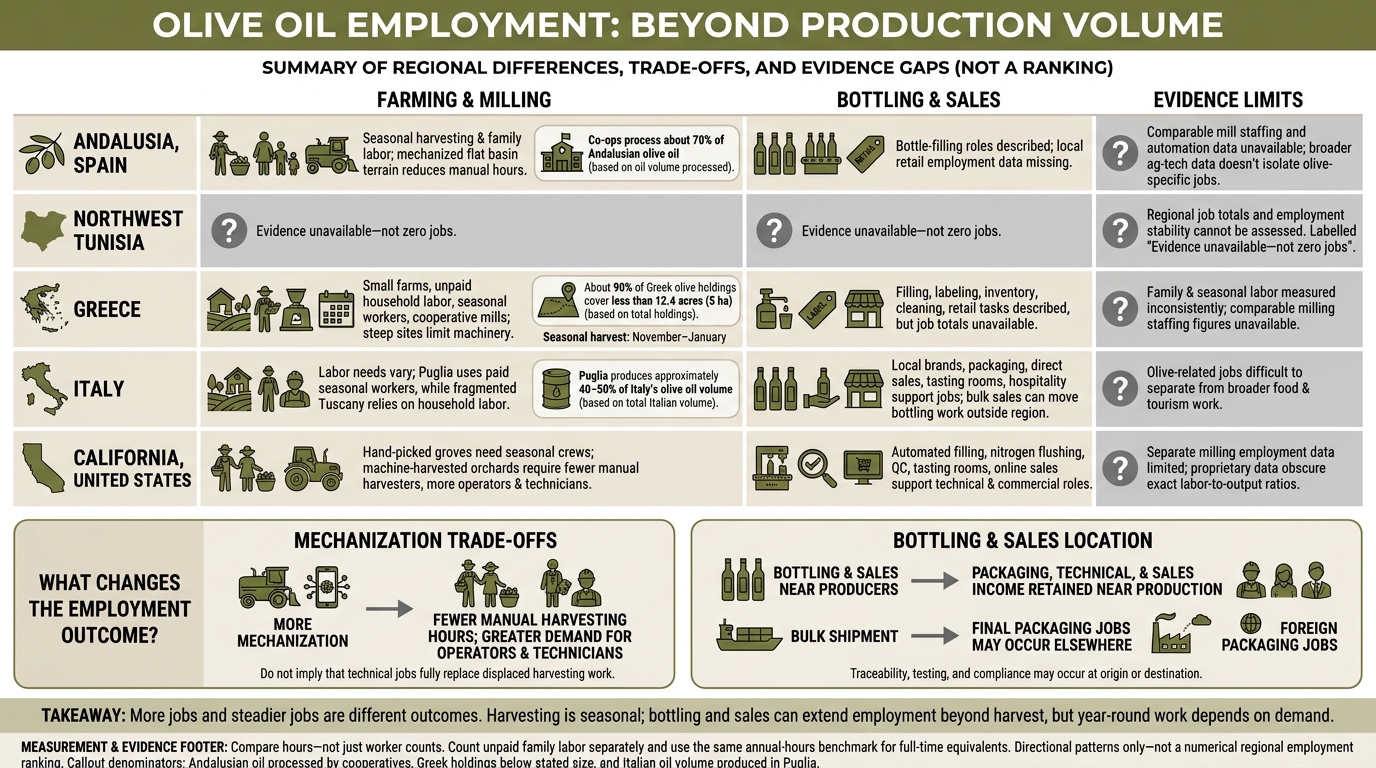
Olive Oil Jobs: Regional Patterns and Employment Trade-Offs
Pakistan's growing olive oil industry brings much-needed jobs
sbb-itb-4066b8e
1. Andalusia, Spain
Most olive-related jobs in Andalusia are in harvesting and cooperative milling.
Farm Work
Small family farms dominate the olive groves in Jaén and Córdoba. Families do most of the fieldwork and hire seasonal workers for the harvest.
Milling Jobs
Cooperatives process about 70% of Andalusia’s olive oil, taking in olives from many small growers. Private mills serve estates or growers under contract, often producing fresh harvest oils for direct sale.
Bottling Jobs
Bottling also provides jobs for bottle fillers.
Local Retail Jobs
The source does not describe local retail jobs.
2. Northwest Tunisia
By contrast, the available sources provide no region-specific employment data for Northwest Tunisia. This gap limits detailed comparisons of its olive oil workforce with those of the better-documented regions discussed next.
Farm Work
The sources provide no details on farm labor, seasonal crews, or mechanization.
Milling Jobs
The sources report no milling staff numbers or job types.
Bottling Jobs
No source links bottling jobs to Northwest Tunisia.
Local Retail Jobs
The sources provide no data on local retail employment in Northwest Tunisia.
3. Greece
Greece’s olive sector centers on small farms, seasonal fieldwork, and cooperatives that handle much of the milling.
Farm Work
About 90% of Greek olive holdings cover less than 12.4 acres (5 hectares). In Crete and the Peloponnese, many cover less than 4.9 acres (2 hectares) and consist of separate parcels. Families depend on unpaid household labor and seasonal workers for the November–January harvest.
Milling Jobs
Hundreds of local cooperatives mill olives for smallholders who lack their own facilities. The sources do not provide figures for milling capacity, staffing, or the split between cooperative and private mills.
Bottling Jobs
The sources do not report how much oil sells in bulk versus branded bottles, so regional bottling employment cannot be estimated. Bottling tasks include filling, labeling, handling inventory, and cleaning equipment.
Local Retail Jobs
Retail workers need product knowledge alongside skills in stocking and other store tasks. The sources do not show how branded sales or tourism affect retail employment in Crete, the Peloponnese, or other olive-producing regions.
4. Italy
Italy’s olive oil jobs vary by region, from large-scale farm and milling work in Puglia to family labor in Tuscany and bottling and retail roles in Sicily.
Farm Work
Farm size and ownership shape labor needs. Puglia’s larger, intensive farms depend on paid seasonal workers. Calabria’s smallholdings use both family and seasonal labor, while cooperatives handle processing and sales.
Sicily has a mix of family plots and larger estates. In Tuscany, fragmented ownership keeps household labor at the center of farm work.
Milling Jobs
Puglia has Italy’s highest processing capacity and produces approximately 40–50% of the country’s olive oil volume. Large industrial mills and cooperatives handle that output.
Calabria’s cooperatives help small growers process their harvests. Tuscany’s small frantoi, or olive mills, fit its fragmented farm structure and reliance on family labor.
Bottling Jobs
Olive oil processing feeds jobs in branded bottling and packaging, though bulk sales can shift bottling work outside the producing region.
Sicily’s estate bottling and Tuscany’s local bottling support roles in filling, labeling, and inventory.
Local Retail Jobs
Branded olive oils also create work in retail and direct sales. Tuscany’s premium branding supports direct-to-consumer selling, while Sicily’s DOP and IGP labels support specialty retail and food service.
These sales channels add jobs in direct sales, tasting rooms, and hospitality.
5. California, United States
Farm Work
Harvest methods shape California’s olive oil jobs. Smaller groves, often family-owned or boutique, rely heavily on seasonal crews to pick olives by hand or use handheld shakers. Super-high-density orchards use more machinery, reducing the need for manual harvesters while creating demand for skilled machine operators and technicians.
These production methods create different job patterns across the state, shifting more work from hand labor to machine operation and downstream packaging.
Milling Jobs
The source material does not provide a separate breakdown of California milling jobs.
Bottling Jobs
Retail-focused businesses may bottle oil on-site at the point of sale to keep tasting rooms and local customers supplied. Bottling work is becoming more technical, with jobs involving automated filling lines, nitrogen-flushing equipment, and quality control.
Local Retail Jobs
Sales work provides steadier employment than seasonal harvesting. Tasting rooms and farm shops support year-round hospitality and education roles, including Olive Oil Educators and Tasting Room Associates.
Online sales add jobs in e-commerce management, digital marketing, and temperature-controlled fulfillment. Wholesale channels also need staff for logistics, account management, and food-safety compliance.
Comparing Farm and Milling Work
Across these regions, terrain and farm structure shape how much harvesting stays manual. The source provides more detail for comparing farm work than milling jobs.
Farm Work
Flat groves allow more machinery; steep groves require more hand labor. That difference affects whether workers pick olives, operate machines, or do both.
| Region | Farm-work evidence in the source |
|---|---|
| Andalusia, Spain | Flat basin terrain allows mechanized harvesting, reducing manual labor hours. |
| Northwest Tunisia | No region-specific farm-labor evidence is provided. |
| Greece | Steep sites limit machinery access, so workers rely more on manual climbing and portable limb shakers. |
| Italy | Fragmented farms in Tuscany and smallholdings in Calabria depend more on family and seasonal labor. |
| California, United States | Central Valley terrain allows mechanized harvesting, reducing manual labor hours. |
The source does not provide comparable grove-density or staffing figures. Milling data has similar gaps, with less detail on staffing patterns.
Milling Jobs
The source provides no comparable mill-level staffing or automation data for the five regions.
| Region | Missing milling employment data |
|---|---|
| Andalusia, Spain | Mill staffing and automation data are not provided. |
| Northwest Tunisia | Mill staffing and automation data are not provided. |
| Greece | Mill staffing and automation data are not provided. |
| Italy | Mill staffing and automation data are not provided. |
| California, United States | Mill staffing and automation data are not provided. |
Without mill-level records, staffing comparisons cannot go further. Bottling and retail show a different pattern, with more year-round roles.
Comparing Bottling and Local Retail Jobs
Olive-growing regions don’t always keep bottling and retail jobs after milling. Oil may be bottled at origin, shipped in bulk, or packaged closer to consumers. Where these steps happen affects where year-round work develops.
Bottling Jobs
Bulk shipping keeps handling and transport work at origin but moves final packaging elsewhere. Local bottling keeps more filling, labeling, and quality-control jobs near production.
| Roles | Skills | Work duration | Location relative to production | Value retained locally |
|---|---|---|---|---|
| Filling, capping, labeling, packing | Equipment operation, accuracy, cleanliness | Based on orders or regular demand; not necessarily year-round | At origin or a destination bottler | Packaging wages where bottles are filled |
| Warehousing and bulk handling | Inventory control, safe handling, logistics | Seasonal, intermittent, or regular | Production area, port, or distribution hub | Handling and storage income |
| Testing, sensory evaluation, traceability, food safety compliance | Technical training, recordkeeping, sensory skills | May cover several lines or facilities | Mills, bottlers, or regional testing sites | Technical wages where services occur |
| Certification, compliance, branding | Standards knowledge, documentation, marketing | May serve several facilities | Often regional or importing hubs | Commercial and specialist income |
Traceability, testing, and compliance jobs can remain at origin or at the destination facility.
Local Retail Jobs
Retail adds jobs, but those jobs follow the sales channel more than the grove.
| Channel and market structure | Product format | Job stability | Main skills and direct jobs | Locally retained value |
|---|---|---|---|---|
| Farm shops and cooperative stores; on-site sales | Direct-from-mill oil, bulk or bottled | Seasonal peaks; continuity varies | Sales, product knowledge, stock handling | Direct-sales income near producers |
| Specialty retailers and education-led sales | Bottled or filled for sale | Can extend beyond harvest; depends on demand | Customer education, merchandising, filling, fulfillment | Retail and service income where sold |
| Farmers’ markets and seasonal fairs; off-site direct sales | Packaged oil | Depends on selling schedules | Customer service and product knowledge | Sales income at the market location |
| Regional distributors; business-to-business wholesale | Cases, pallets, or bulk containers | Regular work where order volumes support it | Warehousing, delivery, inventory, wholesale sales | Distribution wages and margins at the hub |
In October 2026, Big Horn Olive Oil Company in Reno used bottle-filler roles that combined filling, capping, labeling, stocking, customer help, and cleanup.
Job Trade-Offs and Main Findings
More jobs and steadier jobs are different outcomes. Mechanization moves labor from harvesting into machinery and technical work. Local bottling and branded sales can extend employment beyond the harvest season.
The common trade-off: mechanized systems need fewer harvest workers, while downstream activities can offer more skilled, steadier work.
| Region | Employment advantages | Employment disadvantages | Evidence limits |
|---|---|---|---|
| Andalusia, Spain | Technical and maintenance roles support production. | Harvest work remains seasonal. | Broader ag-tech data do not isolate olive-specific jobs. |
| Northwest Tunisia | Rural livelihood benefits cannot be established at the regional level. | Employment stability cannot be assessed at the regional level. | Informal household labor is undercounted; northwest totals are unavailable. |
| Greece | Family farms sustain rural livelihoods. | Fragmented holdings limit full-time technical roles. | Family and seasonal labor are measured inconsistently. |
| Italy | Branding and packaging support retail and agritourism jobs. | Production costs and pests threaten livelihoods. | Olive jobs are hard to separate from broader food and tourism work. |
| California, United States | Bottling and retail can support year-round work. | Efficient harvesting requires fewer field workers. | Proprietary data obscure exact labor-to-output ratios. |
Comparisons across these five regions depend on how labor is counted.
Compare hours, not just headcounts. Seasonal jobs cover limited periods. Count workdays and unpaid household labor separately, then convert all labor to full-time equivalents using the same annual-hours benchmark.
Set the accounting boundary before counting jobs. Within that boundary, farming, milling, bottling, and retail jobs count as direct employment. Supplier jobs are indirect, while jobs supported by spending are induced. Count each job only once, and don't automatically classify tourism work as induced employment.
The source base is uneven, so read these findings as directional - not as a numerical ranking. Regions differ in data quality, labor formality, and coverage of direct, indirect, and induced jobs. The cited company posting documents tasks, not regional employment levels or job stability.
FAQs
Can seasonal olive workers transition to year-round jobs?
Yes. While harvesting and milling are seasonal, workers can move into year-round roles in maintenance, administration, and storage. Olive oil cooperatives and high-end producers also offer steady work in technical advising, quality control, and marketing.
Retail locations, such as Big Horn Olive Oil, offer jobs educating customers about products, keeping staff employed beyond the harvest season.
How can small growers keep more jobs local?
Small growers can join cooperatives to share processing, bottling, and marketing resources. By working together, they can bypass low-paying bulk channels and keep more revenue and jobs local instead of outsourcing.
Coordinating harvests and transport gets olives to the mill within 2 to 4 hours, supporting local mill operators and transport workers. Traceable, high-quality production helps growers earn premium prices, stabilize their businesses, and protect local jobs by relying less on volatile, low-margin markets.
What data would make regional job comparisons fairer?
Researchers need standardized labor data that use the same coverage, reference periods, and definitions. Matched wage data should separate workers by job type, seniority, contract status, and hours worked. They should also distinguish paid employment from unpaid family labor, which often goes unrecorded.
Full-time equivalents and membership totals are not interchangeable. To compare them fairly, researchers need consistent, long-term records showing actual payments, who makes decisions, and who controls each person’s earnings.