

EU Traceability Rules for Olive Oil
The European Union has strict rules to ensure the quality and origin of olive oil, protecting both consumers and producers. These rules require detailed tracking of olive oil from the grove to the bottle, with producers maintaining records for every batch. Labels must clearly state the oil's category, origin, and meet specific standards like acidity levels for extra virgin olive oil (below 0.8%). Containers are limited to 5 liters and must have tamper-proof closures.
Key regulations include:
- Regulation (EU) No 1308/2013: Sets the foundation for agricultural market standards.
- Commission Delegated Regulation (EU) 2022/2104: Covers labeling, marketing standards, and storage rules.
- Commission Implementing Regulation (EU) 2024/2707: Focuses on non-compliance reporting and sampling methods.
Member States conduct annual inspections, with at least one check per 1,000 tons of marketed olive oil. However, traceability practices vary, with countries like Italy using advanced electronic systems, while others rely on manual tracking, leading to inconsistencies.
For producers like Big Horn Olive Oil, these rules align with their commitment to high-quality products, ensuring transparency and fair competition in the market.
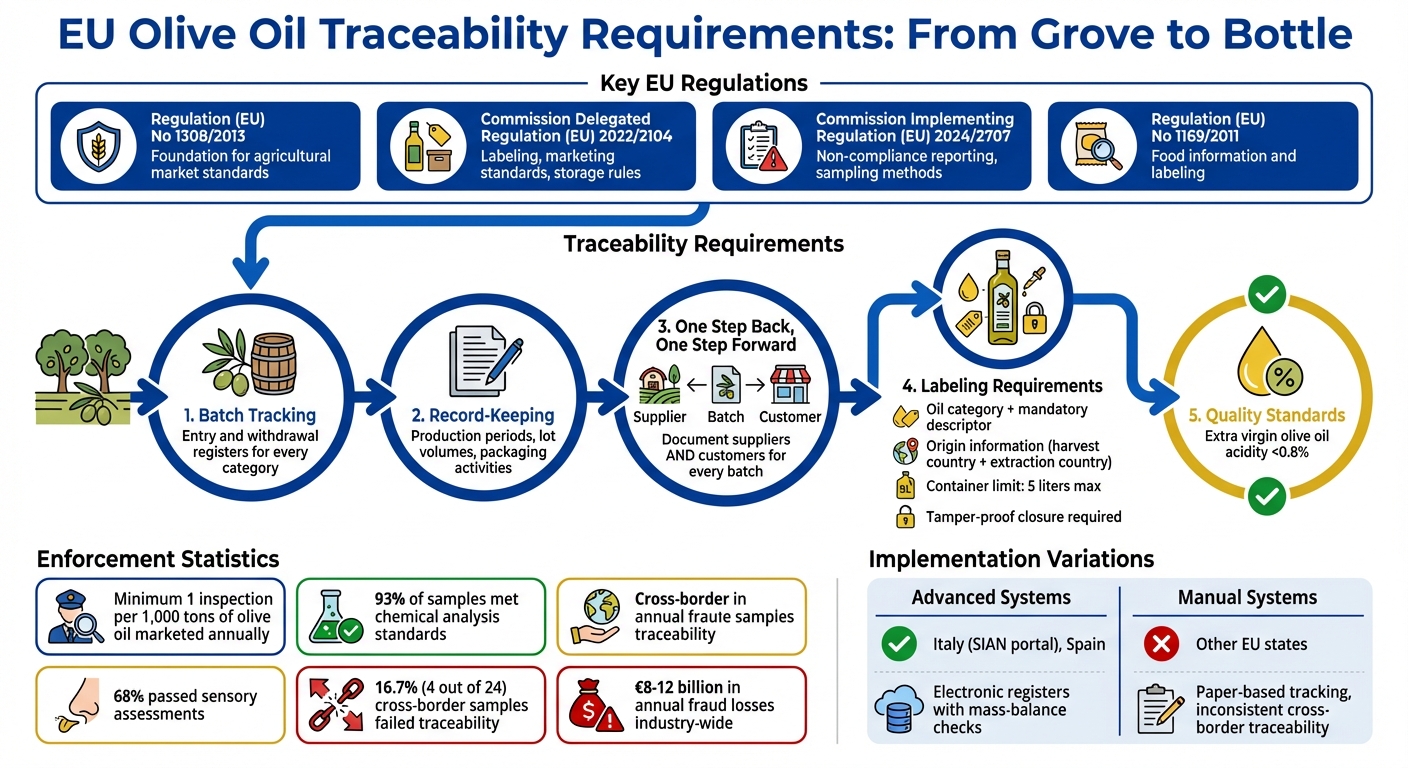
EU Olive Oil Traceability Requirements: From Grove to Bottle
EU Legal Framework for Olive Oil Traceability
Primary Regulations for Olive Oil Traceability
The EU has built a comprehensive legal framework to ensure the traceability and authenticity of olive oil, anchored by several key regulations. At its core is Regulation (EU) No 1308/2013, which establishes the common organization of agricultural markets across the EU. This regulation serves as a foundation, paving the way for more detailed rules.
In November 2022, the EU introduced two significant updates. Commission Delegated Regulation (EU) 2022/2104 set precise marketing standards, categorized different oil types, and enforced mandatory labeling rules for origin and storage. At the same time, Commission Implementing Regulation (EU) 2022/2105 laid out conformity check procedures, analytical methods, and required operators to maintain detailed entry and withdrawal records at every stage - from milling to bottling.
More recently, Commission Implementing Regulation (EU) 2024/2707, effective November 11, 2024, added further clarity. It defined procedures for reporting non-compliance through the Rapid Alert System for Food and Feed (RASFF) and aligned sampling methods with International Olive Council standards. These regulations complement Regulation (EU) No 1169/2011, which governs food information and labeling across the EU.
The enforcement process is stringent. Member States must conduct at least one conformity check per 1,000 tons of olive oil marketed annually. If a sample of extra virgin olive oil is found to be non-compliant - especially if it has organoleptic defects - it must be reported through RASFF. Packaging for consumers is also tightly regulated: it cannot exceed 5 liters (1.3 gallons) and must feature a non-resealable opening.
Together, these regulations aim to uphold transparency, deter fraud, and build consumer trust by ensuring that every bottle of olive oil meets established standards.
Objectives of EU Traceability Standards
The EU’s traceability standards are driven by three main objectives: transparency, fraud prevention, and consumer confidence. By requiring meticulous documentation at every production stage, the regulations enable each bottle of olive oil to be traced back to its origins, including the specific olives, harvest, and mill involved in its creation.
"The olive oil marketing standards protect European Union (EU) consumers and businesses from misdescribed and adulterated olive oil products. The standards ensure olive oil is marketed fairly, facilitating trade, and provide a deterrent against fraud." – European Union
Fraud prevention is particularly crucial due to the high value of extra virgin olive oil. The regulations enforce strict physicochemical standards, such as fatty acid profiles, sterol content, acidity levels (extra virgin olive oil must have an acidity below 0.8%), and peroxide indexes. These measures ensure lower-quality oils cannot be mislabeled and sold as premium products. For producers like Big Horn Olive Oil, these standards validate their commitment to quality, offering consumers confidence that the product matches its label.
The framework also ensures fair competition. Whether olive oil is made within the EU or imported, all products are held to the same quality benchmarks. This levels the playing field and protects legitimate producers from being undercut by adulterated or mislabeled oils. Operators are required to back any labeling claims - such as origin or terms like "cold extraction" - with verifiable documentation, analytical results, or accounting records that can be provided to authorities upon request.
These regulations not only establish robust processes but also strengthen the traceability system, ensuring integrity across the olive oil supply chain.
sbb-itb-4066b8e
Traceability Requirements for Olive Oil Producers
Batch Tracking and Record-Keeping
Producers are required to maintain entry and withdrawal registers for every olive oil category. These registers meticulously track the movement of oil throughout the supply chain, creating a comprehensive record that can be reviewed during inspections.
The records must include details such as production periods, lot volumes, packaging activities, and the oil's category. This detailed documentation is critical, as authorities use risk-based analysis to confirm that the declared category of the oil aligns with its actual quality.
In addition, producers must be prepared to provide administrative data, sample analytics, or scientific evidence when requested. This information supports claims about the oil, including its origin and optional labeling terms like "cold extraction." For example, companies like Big Horn Olive Oil rely on precise temperature logs and processing records to back up their quality assertions.
Labeling and Origin Information
Accurate record-keeping is also essential for proper labeling, which plays a key role in building consumer trust.
Labels must clearly indicate the oil category and include a mandatory descriptor. For Extra Virgin olive oil, the label must state: "superior category olive oil obtained directly from olives and solely by mechanical means." Virgin olive oil labels, on the other hand, must read: "olive oil obtained directly from olives and solely by mechanical means".
Origin information is required for both Extra Virgin and Virgin olive oils. Labels must specify the country where the olives were harvested and the country where the oil was extracted. If these processes occurred in different countries, both locations must be clearly identified. This transparency measure is vital in combating the olive oil industry's estimated €8 billion to €12 billion in annual fraud losses.
Retail containers must not exceed 5 liters (1.3 gallons) and must include a tamper-proof closure. Additionally, storage instructions must be provided, advising consumers to store the oil in a cool, dark place away from heat and light. Optional terms like "first cold pressing" are permitted only if the oil was extracted at temperatures below 80.6°F (27°C) using traditional hydraulic presses.
One Step Back, One Step Forward Principle
The traceability system further ensures accountability with the one step back, one step forward principle, which requires producers to document both their suppliers and customers for every batch.
Operators must provide documentation that verifies the oil's description, origin, and labeling claims. This system ensures accountability at every stage of the supply chain. If discrepancies are found in traceability records, and intentional fraud is suspected, authorities may issue a food fraud notification alongside standard non-compliance alerts. For instance, if a sample of extra virgin olive oil fails to meet sensory (organoleptic) standards, authorities are obligated to notify the Rapid Alert System for Food and Feed (RASFF).
Importers and distributors, such as Big Horn Olive Oil, must also maintain detailed supplier records. This allows them to trace every bottle's origin, ensuring that any quality issues can be quickly identified and addressed at the specific point in the supply chain where they occurred.
Variations in EU Member State Traceability Practices
Electronic Registers vs. Manual Systems
EU regulations provide a shared framework for olive oil traceability, but how member states implement these systems can vary significantly. For instance, Italy and Spain rely on electronic registers to monitor the movement of olives and olive oil throughout the supply chain. Italy's SIAN portal, a mandatory system, goes beyond standard EU requirements by enabling detailed mass-balance checks. This allows authorities to quickly address any discrepancies.
In February 2026, Italy's ICQRF undertook a data cleanup of the SIAN Olive Oil Portal. This process automatically closed inactive registers dating back to July 1, 2021, covering the 2020/21 and 2021/22 marketing years. Stefano Pasquazi from FOA Italia highlighted the importance of this system:
"Maintaining the Electronic Register correctly is not only a legal requirement, but also a safeguard for the value of the oil produced by our mills".
In contrast, other EU member states still rely on manual systems, which creates inconsistencies in cross-border traceability. Between 2018 and 2023, the European Court of Auditors conducted an audit of control systems in Belgium, Greece, Spain, and Italy. The findings revealed that traceability across borders failed in 4 out of 24 olive oil samples - approximately 16.7%. Joëlle Elvinger, a member of the European Court of Auditors, commented:
"Consumers must be able to trust the quality and authenticity of the oil they purchase. Improving legal clarity is essential to protect the reputation of Europe's green gold".
The audit also showed that while 93% of olive oil samples met their declared category based on chemical analysis, only 68% passed sensory assessments. This gap highlights how oils can pass chemical testing but fail sensory evaluations due to issues like degradation or improper storage - problems that more advanced electronic tracking systems are better equipped to address.
These differences in technology directly affect the regulatory demands placed on producers.
Compliance Challenges for Small Producers
The disparity in tracking systems creates additional hurdles for small producers, especially those with limited resources. In Italy, reopening inactive registers requires direct applications to the ICQRF, adding a layer of bureaucracy. Pasquazi noted:
"An efficient electronic register must reflect the reality of the market: keeping inactive registers open or reporting stocks in tanks that have not been moved for years distorts national statistics and complicates inspections".
Some member states fall short of EU-mandated inspection levels or omit critical market segments from their risk analyses. For example, Greece has consistently performed fewer inspections than required, while Belgium - despite generally meeting inspection thresholds - lacks the electronic tracking systems common in Mediterranean countries. Additionally, national authorities often fail to document their risk analyses or justify their control measures. This results in monitoring gaps, particularly for contaminants and pesticides in imported oils. Although the EU imports about 9% of its annual olive oil supply, checks on these imports are infrequent or entirely absent in several countries.
Special Report 01/2026: Control systems for olive oil in the EU
How Big Horn Olive Oil Meets EU Traceability Standards
Big Horn Olive Oil aligns with EU traceability regulations by combining advanced processing techniques with meticulous documentation practices.
Commitment to Freshness and Quality
To meet traceability standards in countries like Spain and Italy, Big Horn Olive Oil uses electronic records and mass-balance tracking systems that account for every unit of olives processed. They cold-press olives within just 2 hours of harvest, creating a natural record of each batch. This quick turnaround ensures that every bottle of olive oil can be linked back to its harvest date and location. By delivering olive oil within 3 months of harvest, they streamline batch tracking and reduce record-keeping complexities. This efficient approach not only simplifies compliance but also reinforces transparency in their sourcing and labeling processes.
Transparency in Sourcing and Labeling
Big Horn Olive Oil takes transparency seriously, particularly when it comes to sourcing and labeling. Their olives and balsamic vinegars are sourced from Modena, Italy - a region celebrated for its stringent verification systems. Italy’s electronic registers provide a detailed record of origin at every stage, offering an added layer of transparency. As EU regulations continue to evolve, this level of documentation is becoming even more critical. Additionally, by offering single-source options like Picual and Coratina Extra Virgin Olive Oils, Big Horn Olive Oil gives consumers access to detailed origin information. This ensures that authenticity and quality claims can be easily verified.
Conclusion
EU traceability standards go beyond mere regulations - they're essential for ensuring product integrity and earning consumer trust. Through detailed batch tracking, origin verification, and meticulous record-keeping, these standards create a transparent supply chain that benefits both producers and consumers alike.
For producers, certifications like PDO and PGI not only protect their brand but also justify premium pricing. Distributors benefit from the ability to quickly pinpoint and isolate affected batches during food safety incidents. Meanwhile, consumers gain access to verified details like harvest dates, milling locations, and quality standards - meeting the growing demand for "grove-to-table" transparency.
"Introducing minimum control requirements for all Member States should also help to combat fraud."
- Commission Implementing Regulation (EU) 2022/2105
Enforcement measures further strengthen these safeguards. Member States enforce strict and proportionate penalties for non-compliance, while dual counter-assessments ensure fairness in disputed tasting panel results.
For businesses like Big Horn Olive Oil, aligning with EU traceability standards isn't just about compliance - it's a strategic move. By maintaining comprehensive records, verifying supplier documentation, and prioritizing transparency, quality-driven producers can turn these standards into a competitive edge that fosters long-term consumer trust.
FAQs
What records prove an olive oil’s origin?
Records that confirm an olive oil's origin typically include certification documents such as PDO (Protected Designation of Origin) and PGI (Protected Geographical Indication) certificates. Additionally, traceability data and compliance checks play a key role. These processes often involve batch tracking and other verification methods to ensure the product meets EU standards for both authenticity and quality.
How do EU lab tests and taste panels differ?
EU lab tests play a crucial role in examining the chemical and physical properties of olive oil. These tests look at factors like purity, possible contaminants, and quality benchmarks, all through precise scientific methods. Meanwhile, taste panels focus on sensory aspects - trained evaluators assess the aroma and flavor to detect any defects and highlight the oil's characteristics. By combining hard data from lab analyses with sensory evaluations, this process ensures thorough traceability and helps confirm quality classifications, such as the coveted "extra virgin" label.
What should I look for on an EU olive oil label?
When choosing olive oil, look for key details that indicate its quality. Check the grade, such as "extra virgin", and ensure there’s a recent harvest date - ideally within the past 18–24 months. Pay attention to the specific source or region listed, as well as the extraction method (cold-extracted is preferred). Certifications like PDO, PGI, or USDA Organic can also confirm the oil’s authenticity and standards.