

Italian Brining Guide: Salt, Time, Olive Type
Safe olive curing starts with a tested method - not a single salt ratio. Sort olives by size and ripeness, then follow that method’s salt measurements, curing schedule, and storage rules. One tested brine method requires at least 2 months, even if bitterness fades sooner.
- Measure carefully: A 10% water-weight brine uses 100 g salt per 1,000 g water. That’s a calculation example, not a formula for every batch.
- Keep olives submerged: Follow all brine-change and temperature instructions. Never taste moldy, slimy, or foul-smelling olives.
- Season after curing: Herbs, citrus, and extra-virgin olive oil add flavor - not preservation. Refrigerate garlic- or herb-in-oil mixtures at 40°F or below and use within 4 days, or sooner if required.
The rule is simple: olive type guides method selection; the tested method sets the salt and time.
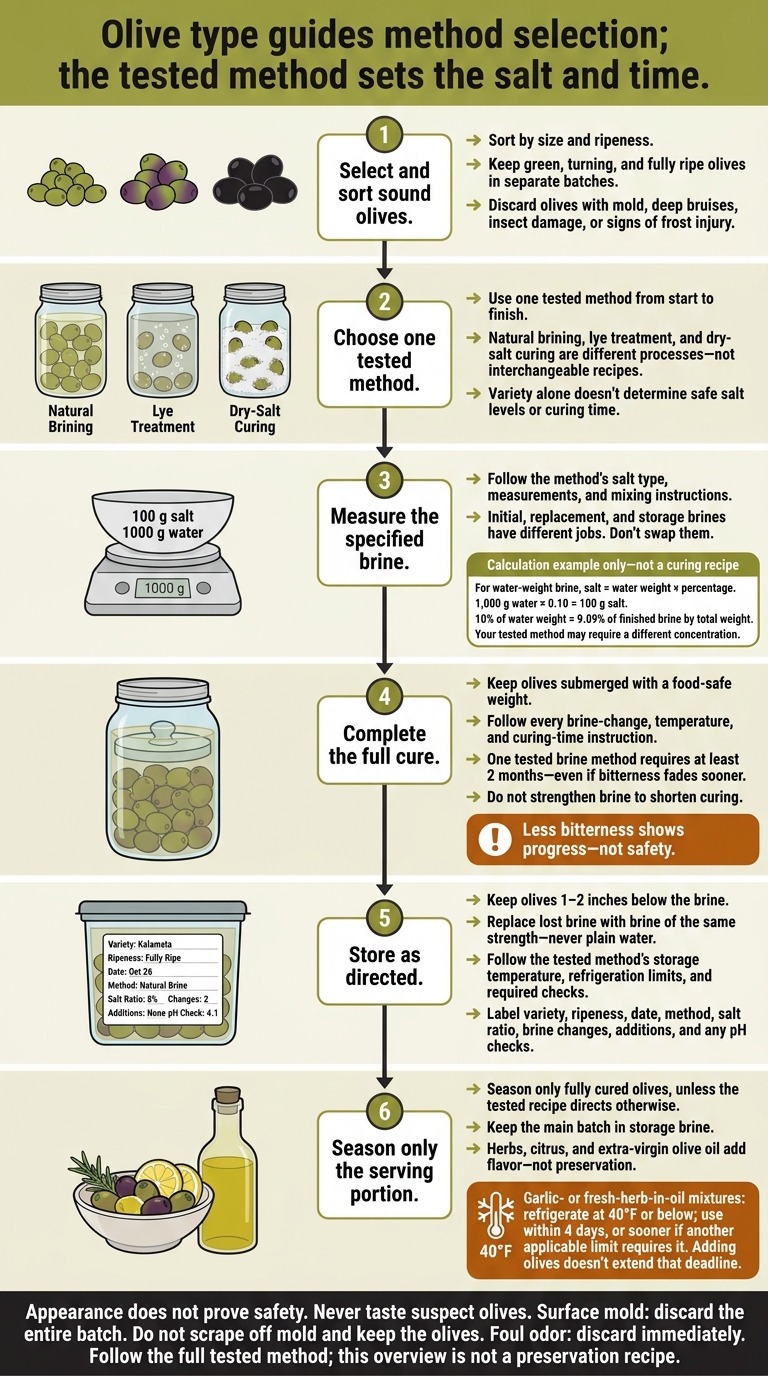
Safe Olive Brining: From Sorting to Serving
Choose Olives by Variety and Ripeness
Once you’ve chosen a curing method, sort the olives by variety, ripeness, and condition. Discard any with mold, deep bruises, insect damage, or signs of frost injury. Keep green, turning, and fully ripe olives in separate batches so they cure evenly, and use a tested method for each batch.
Italian Olive Varieties and Their Curing Methods
Gaeta is a style linked to Itrana olives, not a separate cultivar. The common styles below show how ripeness affects curing. UC ANR does not give cultivar-specific salt levels or curing times for these olives.
| Variety or style | Harvest stage | Customary preparation | Texture tendency | Flavor tendency |
|---|---|---|---|---|
| Nocellara del Belice | Green or turning | Green or turning preparations | Firmer when green | Bitterness depends on treatment |
| Taggiasca | Often ripe | Ripe brined or dry-salt styles | Softer when ripe | Depends on cure |
| Gaeta-style Itrana | Ripe | Natural brining | Often dark and wrinkled | Savory |
| Cerignola | Large, firm fruit | Tested method suited to large fruit | Large and firm | Bitterness depends on treatment |
| Leccino | Often ripe | Ripe brined or dry-salt styles | More prone to softening when ripe | Depends on cure |
Natural brining, lye treatment, and dry-salt curing are different processes, not recipes you can swap for one another.
How Size and Ripeness Affect Curing
Size and ripeness affect how much brine stress olives can tolerate. Follow the salt level specified for the tested method and fruit size: stronger brine can make large olives shrivel. Green olives usually need more bitterness reduction, while ripe olives soften faster.
sbb-itb-4066b8e
Measure Brine and Follow the Curing Schedule
Once you’ve matched olive variety and ripeness, measure the brine strength for your chosen cure. Initial, replacement, and storage brines have different jobs. Initial brine starts the cure, replacement brine follows the recipe’s schedule, and storage brine holds fully cured olives. Don’t swap them or dilute a batch just because it tastes salty.
Understand Salt Percentages Before Mixing
For water-weight brine, salt = water weight × percentage.
Example: 1,000 g water × 0.10 = 100 g salt; that equals 9.09% of the finished brine by total weight.
A percentage based on water weight isn’t the same as one based on total brine weight. Use a digital scale, potable water, and the salt type and mixing temperature specified in the tested recipe.
Calculate Brine for U.S. Kitchen Measurements
These 10% water-weight conversions are measuring aids only. Your curing method may call for a different concentration. Weigh water and salt in grams, and record the salt brand and type. Crystal size and packing vary, so cups or tablespoons of another salt can’t replace a required weight - or a recipe’s measurements for a particular pickling salt.
| Water volume | Approx. water weight | Salt at 10% of water weight |
|---|---|---|
| 1 U.S. quart | 946 g / 2.09 lb | 94.6 g / 3.34 oz |
| 2 U.S. quarts | 1,892 g / 4.17 lb | 189.2 g / 6.67 oz |
| 1 U.S. gallon | 3,785 g / 8.35 lb | 378.5 g / 13.35 oz |
| 2 U.S. gallons | 7,570 g / 16.69 lb | 757.0 g / 26.70 oz |
Use these conversions for measurement only, then match your olives to the curing schedule below.
Match Olive Condition to a Tested Curing Timeline
Use this table alongside your chosen tested method - not to build a recipe from parts of different methods. Ounces per gallon means salt weight per volume of water, not a percentage.
| Olive condition | Applicable tested method | Salt concentration and convention | Typical time range | Readiness indicators |
|---|---|---|---|---|
| Large green olives, including Sevillano or Ascolano | Natural brining method for large olives | 10 oz pickling salt per U.S. gallon of cool water; recipe-specific convention | Source gives the concentration but not one universal duration | Avoid excessive shriveling; follow the recipe’s brine-change and readiness instructions. |
| Small green olives, including Manzanillo or Mission | Natural brining method for small olives | 1 lb, approximately 1½ cups, pickling salt per U.S. gallon of cool water; recipe-specific convention | Follow the tested schedule; commonly at least several weeks | Keep olives submerged and evaluate only under the tested method. |
| Very bitter early-harvest green olives | Staged green-olive brine method | Starts at 6 tablespoons per gallon, then 13 tablespoons, then 1 lb or 1⅔ cups per gallon with scheduled replacements | Initial 2 days, 1 week, then 10–12 days; storage or use within 2–4 months under the cited instructions | Desalt before eating; refrigerate after the initial stage. |
| Mature or fully ripe olives | A method validated for mature or black olives | Do not use green-olive brine strengths for ripe olives. | Follow the validated method’s timeline; do not use green-olive timing. | Even cure, sound texture, and normal appearance. |
After the initial cure, keep olives submerged with a food-safe weight and follow the specified storage temperature and brine-change schedule. Don’t strengthen the brine to shorten curing. Appearance does not prove safety. Taste only when the method permits, and never taste a suspect batch. If your olive condition isn’t listed, the brine becomes diluted without explanation, olives lose submersion, or spoilage signs appear, seek validated preservation advice. Don’t guess at salt adjustments or curing times.
Flavor Cured Olives With Herbs, Citrus, and EVOO
Season only fully cured olives, unless your tested recipe calls for seasonings earlier. Keep the main batch in storage brine, and dress only the portion you plan to serve.
Pair Herbs and Citrus With Olive Styles
Let the olive style you selected earlier guide your pairings. Wash lemons or oranges before peeling, then remove most of the white pith to keep extra bitterness out.
| Olive style | Herb-forward | Citrus-forward | Spicy | EVOO finish |
|---|---|---|---|---|
| Large green | Rosemary, thyme, bay leaf | Lemon peel and oregano | Optional garlic, chili, black pepper | EVOO, rosemary, lemon peel |
| Small green | Oregano and marjoram | Lemon peel and coriander seed | Optional chili, garlic, coriander seed | EVOO, thyme, black pepper |
| Ripe dark | Thyme, fennel seed, a small bay leaf | Orange peel and marjoram | Optional chili and black pepper | EVOO, orange peel, fennel seed |
These pairings are serving suggestions, not preservation recipes. Adding vinegar won't make an untested batch safe or shelf-stable.
Dress Cured Olives With Big Horn Olive Oil
Big Horn Olive Oil is an optional source of EVOO for dressing drained, fully cured olives shortly before serving. Add enough to coat them - not submerge them. Oil adds flavor; it doesn't preserve olives or replace storage brine.
Refrigerate garlic- or fresh-herb-in-oil mixtures at 40°F or below, and use them within the shortest safe storage limit: no more than four days, or sooner if another applicable limit requires it. Adding olives doesn't extend that deadline. If you're unsure about storage time or temperature, discard the mixture without tasting.
Store Cured Olives and Check for Problems
After portioning olives for seasoning, return the rest to storage brine.
Keep Olives Submerged and Refrigerated as Directed
Store the remaining olives in clean, food-safe containers with suitable lids. Use sanitized utensils and a food-safe weight to keep the olives 1–2 inches below the brine. Replace any lost brine with brine of the same strength - never plain water.
Follow the tested method’s salt concentration, temperature, curing time, pH checks, and refrigeration limits. Taste, oil, smell, and visible fermentation cannot tell you whether a batch is safe. A single pH reading does not make an improvised batch safe. Refrigerate as the tested method directs.
Label each batch with its variety, ripeness, date, method, salt ratio, brine changes, additions, and any pH checks.
Tell Quality Problems Apart From Spoilage
Cloudiness alone does not tell you whether olives are safe or spoiled. Check the batch against the method’s timeline, expected appearance, and required checks. The table below helps distinguish normal curing changes from spoilage.
| Symptom | Possible causes | Appropriate action |
|---|---|---|
| Shriveling | Dry fruit, strong brine, prolonged curing, or moisture loss | Check the salt calculation and schedule. Discard if shriveling is severe or comes with signs of spoilage. |
| Excessive bitterness | Variety, immature fruit, incomplete curing, or missed water changes | Follow the tested schedule. Do not shorten the cure. |
| Cloudy brine | Normal fermentation, yeast, contamination, or low salt | Check whether the method calls for this change. Discard if cloudiness comes with slime, foul odor, or unexpected breakdown. |
| Surface mold | Air exposure, floating olives, or contamination | Discard the entire batch. Do not scrape off the mold and keep the olives. |
| Soft texture | Overripe fruit, heat, overcuring, or microbial breakdown | Discard if softness is abnormal or comes with slime, collapse, foul odor, or rapid breakdown. |
| Excessive saltiness | Overly strong brine or insufficient desalting | Desalt only a safely cured serving portion. Leave the storage brine unchanged. |
| Foul odor | Spoilage or contamination | Discard immediately. |
If a batch falls outside these patterns, discard it rather than trying to fix it. Never taste suspect olives. Spoiled olives cannot be made safe. Make desalting and seasoning adjustments only to safely cured serving portions, then follow the finished preparation’s refrigeration and use-by limits.
Conclusion: Weigh Salt and Follow the Tested Method
Use one tested method from start to finish to match olive type, salt strength, and curing time. Start with sound olives sorted by size and ripeness. Variety alone doesn’t determine safe salt levels or curing time. Weigh salt exactly as directed: percentages based on water weight and total brine weight are not interchangeable.
Natural brining takes months, not days. Complete the full cure, keep olives submerged, and follow every instruction for brine changes and storage. Less bitterness shows progress - not safety.
Once the olives are safely cured, dress only the portion you plan to serve with herbs, citrus zest, and EVOO from Big Horn Olive Oil. Refrigerate dressed olives and use them within the finished preparation’s storage limit. Oil adds flavor; it doesn’t extend safe storage.
FAQs
Where can I find tested olive-curing recipes?
Look for tested olive-curing methods in resources on long-used preparation methods, such as Big Horn Olive Oil’s guides. These explain how to soak olives in water to remove bitterness, mix salt brines, and follow fermentation timelines for different olive varieties.
Choose recipes with clear salt measurements by weight and specific schedules for checking safety and quality. Follow the tested recipe’s instructions - not just the calendar.
Can I cure pitted or cracked olives in brine?
Yes. Pitting or cracking olives lets brine reach the flesh and draw out bitterness. Remove the stems, and discard any olives with bruises, soft spots, or signs of insect damage.
Use a food-safe weight to keep the olives completely submerged in 10% salt brine to help prevent spoilage. Once they’re cured to your taste, finish them with high-quality EVOO from Big Horn Olive Oil.
How do I safely desalt cured olives before seasoning?
Drain the olives and rinse thoroughly under cool running water. If they’re still too salty, soak them in clean, unchlorinated water for 4–8 hours for a small salt adjustment, or 7–14 days to remove more salt. Change the water daily.
When the olives reach your preferred salt level, drain them well. Spread them in a single layer on clean towels or a food-safe rack. Let the surfaces dry before marinating or infusing with oil.